Many parents in Pakistan want to transfer their house, residential plot, commercial property or agricultural land to their children during their lifetime.
One common way to do this is through a Gift Deed (Hiba).
However, property owners often ask important questions:
- Can a father gift property to his son without Capital Gains Tax?
- Can a mother transfer property to her daughter?
- Is property received from parents taxable income?
- Is stamp duty payable on a family gift in Punjab?
- Are FBR advance taxes under Sections 236C and 236K applicable?
- How should the gift appear in the donor's and recipient's Wealth Statements?
- What records should be maintained to avoid future FBR notices?
For Tax Year 2027 (July 1, 2026 to June 30, 2027), Pakistan's income tax law provides special treatment for genuine transfers of assets by gift between qualifying relatives.
Additionally, Punjab introduced an important stamp duty concession for specified close-family gift deeds through the Stamp (Second Amendment) Ordinance, 2026.
This AsaanTax.pk guide explains how to transfer property from parents to children, the relevant FBR rules, documentation requirements, legal registration procedure and common mistakes to avoid.
What Is a Property Gift or Hiba in Pakistan?
A property gift is a voluntary transfer of ownership from one person to another without receiving a purchase price.
The person giving the property is called the Donor.
The person receiving the property is called the Donee.
For example:
A father owns a residential plot in Lahore.
He decides to give the plot to his daughter without receiving any payment.
If the gift is genuine and the applicable legal requirements are fulfilled, ownership can be transferred through the appropriate gift and property registration procedure.
A gift differs from an ordinary sale because the donor does not receive sale consideration.
Can Parents Gift Property to Their Children in Pakistan?
Yes.
A father or mother can transfer property to a son or daughter through a lawful gift transaction, subject to ownership rights and the applicable property laws.
Possible examples include:
- Father gifting a house to his son.
- Father gifting a plot to his daughter.
- Mother gifting agricultural land to her son.
- Mother gifting an apartment to her daughter.
- Parents gifting specified ownership shares to multiple children.
The donor must have the legal right to gift the property.
Where the property is jointly owned, a person generally cannot gift more than the share or interest they lawfully own.
Is Property Gifted by Parents Tax-Free Under FBR Rules?
A genuine gift between qualifying relatives may receive special federal income tax treatment.
Two major provisions are relevant:
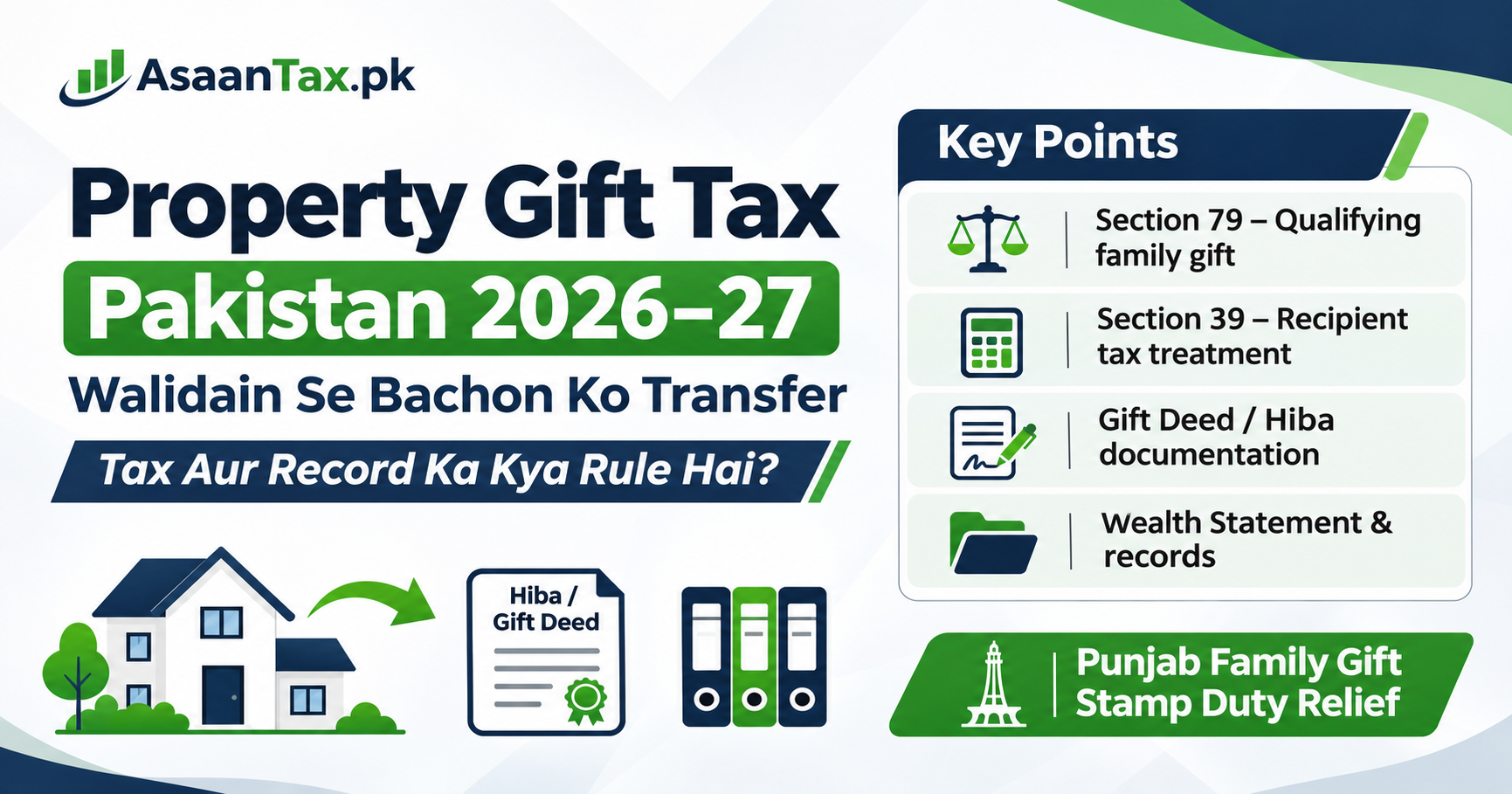
Section 79 – Non-Recognition Rules
Section 39 – Income from Other Sources
These provisions address different sides of the gift transaction.
Section 79 concerns the person disposing of the asset.
Section 39 concerns whether the recipient's gift is treated as taxable income.
Additional withholding-tax and property registration rules must be examined separately.
Section 79 – Capital Gains Tax on Gift to Children
Section 79(1)(c) of the Income Tax Ordinance, 2001 provides non-recognition treatment for a gift of an asset to a qualifying relative.
For this purpose, the term relative is defined in Section 85(5).
What Does Non-Recognition Mean?
Where the requirements are satisfied, no gain or loss is recognized on the disposal of the property by reason of the gift.
Example
A father bought a residential plot for Rs. 2,000,000 several years ago.
The property is now worth Rs. 8,000,000.
The father genuinely gifts the plot to his son.
Assuming the transaction qualifies under Section 79, the father does not recognize a capital gain merely because the property was gifted to his son.
Important: The increase in market value does not automatically create taxable capital gain at the time of a qualifying gift.
However, Section 79 does not by itself waive every property registration or withholding obligation.
Section 39 – Is Property Received as a Gift Taxable?
Section 39(1)(la) generally deals with amounts or property received without consideration or as gifts.
However, the provision excludes gifts received from qualifying relatives as defined in Section 85(5).
Therefore, a genuine gift received by a son or daughter from their parent is generally not included as taxable income under this gift-income provision.
Example
A mother gifts a property worth Rs. 10,000,000 to her daughter.
The daughter receives the property without paying the mother.
Assuming the gift is genuine and the legal relationship and other conditions are established, the property generally falls within the qualifying family-gift treatment under Section 39.
The daughter should nevertheless maintain proper documentation of the acquisition.
Tax-exempt treatment does not mean the asset can be omitted from legally required financial disclosures.
Section 85 – Who Is Considered a Relative?
Section 85(5) contains the definition of relative for the relevant federal income tax provisions.
It is broader than only parents and children.
Depending on the statutory wording and relationship, the definition includes categories such as:
- Parents and grandparents.
- Sons and daughters.
- Other qualifying descendants and ancestors.
- Spouses.
- Brothers and sisters.
- Certain other qualifying family relationships.
The precise statutory definition must be used.
For example, the federal income tax definition should not automatically be substituted for a provincial stamp duty provision that specifies a narrower list of relationships.
Punjab Stamp Duty Exemption on Family Gifts – October 2026 Update
Punjab introduced significant stamp duty changes through the Stamp (Second Amendment) Ordinance, 2026, reported as effective from October 20, 2026.
The new framework provides stamp duty exemption for qualifying gift deeds between specified close family members.
The specified categories include:
- Parents and children.
- Spouses.
- Grandparents and grandchildren.
- Siblings.
- Certain other expressly specified close-family relationships.
What Is the Benefit?
Before this change, qualifying family gift deeds could attract percentage-based stamp duty under the earlier Punjab framework.
Under the new ordinance, the relevant qualifying family gift deed can benefit from stamp duty exemption.
Important Conditions
Before executing a gift deed, check:
- Whether the property is located in Punjab.
- Whether the relationship qualifies.
- Whether the instrument qualifies as a genuine gift.
- Whether the current ordinance remains legally operative.
- Whether the specific transaction requires any other fee or duty.
Stamp duty exemption does not automatically remove mutation, registration, society transfer, documentation or other applicable charges.
This Punjab change should not automatically be applied to Sindh, Khyber Pakhtunkhwa, Balochistan or Islamabad.
Gift Deed Stamp Duty – Province-Wise Overview
| Jurisdiction | General Position |
|---|---|
| Punjab | October 2026 exemption introduced for specified close-family gift deeds |
| Sindh | Applicable provincial stamp and registration laws must be checked |
| Khyber Pakhtunkhwa | Relevant provincial rules and current fee schedule apply |
| Balochistan | Provincial property transfer rules apply |
| Islamabad | Applicable ICT registration and stamp duty rules must be verified |
There is no single nationwide provincial stamp duty rate for every gift deed.
For Punjab, use the current official e-stamping system to determine applicable charges.
Section 236C and Section 236K – Is Advance Tax Payable on a Gift?
This is one of the most important questions when transferring property through a gift deed.
Section 236C
This provision concerns advance income tax collected from a seller or transferor of immovable property under applicable circumstances.
Section 236K
This provision concerns advance income tax collected from a purchaser or transferee of immovable property.
Why Does a Gift Need Separate Examination?
A genuine parent-to-child gift involves a transferor and transferee, but ordinarily no sale consideration.
Federal capital gains non-recognition under Section 79 is a separate question from tax collection under Sections 236C and 236K.
FBR has historically issued guidance concerning family transfers, and actual withholding treatment may involve the relevant rules, exemptions and documentation accepted by the transfer authority.
Therefore:
Do not automatically calculate ordinary property sale and purchase withholding rates on a qualifying gift without checking the applicable legal exemption or transfer procedure.
Equally, do not assume every gift is automatically exempt merely because the recipient is a family member.
Obtain confirmation from the relevant registrar, housing society, development authority or competent FBR office before payment and transfer.
Difference Between Gift, Sale and Inheritance
| Feature | Gift | Sale | Inheritance |
|---|---|---|---|
| Transfer basis | Voluntary gift | Purchase for consideration | Succession after death |
| Payment to former owner | Normally none | Yes | Not a purchase price |
| Typical document | Gift deed / Hiba records | Sale deed | Succession or inheritance documents |
| Capital Gains Tax | Section 79 may apply for relatives | Normal disposal rules may apply | Specific succession rules |
| Financial reporting | Gift and asset transfer | Sale proceeds and asset disposal | Inherited asset disclosure |
| Provincial charges | Gift-specific treatment | Sale-specific treatment | Succession-specific treatment |
A genuine gift should not be misdescribed as a sale simply to use a different registration procedure.
Likewise, a transfer made after death should not automatically be treated as a lifetime gift.
How to Transfer Property From Father to Son or Daughter
Step 1: Verify Property Ownership
Confirm that the father or mother is the lawful owner of the property.
Examine the registry, allotment letter, title, mutation and other relevant records.
Step 2: Check Property Restrictions
Confirm whether the property is subject to:
- Mortgage or financing.
- Court proceedings.
- Ownership disputes.
- Society transfer restrictions.
- Outstanding dues.
- Other legal encumbrances.
Step 3: Verify the Family Relationship
Obtain relevant identity records showing the donor and recipient's relationship.
Step 4: Prepare the Gift Deed
The deed should identify:
- Donor.
- Donee.
- Property.
- Ownership interest.
- Declaration of gift.
- Acceptance.
- Relevant possession arrangements.
- Other legally necessary details.
Step 5: Check Applicable Stamp Duty and Taxes
Use the current provincial rules and confirm federal withholding treatment.
Step 6: Complete the Required Registration
Follow the relevant Sub-Registrar, land revenue or housing society procedure.
Step 7: Complete Mutation or Society Record Changes
Ensure that the ownership record is correctly updated.
Step 8: Preserve the Official Documents
Keep certified copies and acknowledgments.
Step 9: Update Relevant Tax Records
Where the donor or recipient is required to file a Wealth Statement, reflect the property transfer correctly.
What Are the Essential Legal Requirements of Hiba?
For a gift governed by Muslim personal law, the basic elements generally include:
- A clear declaration of gift by the donor.
- Acceptance by the donee.
- Delivery of possession, actual or legally recognized constructive possession, as applicable.
The exact legal position can vary according to the personal law, the property, the donee's age and the transaction circumstances.
For immovable property, registration and documentary requirements must also be considered under the relevant law.
A written document alone may not resolve every legal question concerning the validity of a disputed gift.
A properly documented registered gift and updated ownership record provide useful evidence.
Can Property Be Gifted to a Minor Child?
A property gift to a minor may be possible, subject to applicable law.
However, additional legal considerations can arise concerning:
- Acceptance of the gift.
- Legal guardian.
- Possession.
- Management of the property.
- Representation during registration.
- Relevant family and personal-law rules.
Where the donor is also the minor's guardian, the facts should be reviewed carefully.
Professional legal assistance is advisable for gifts involving minors.
Documents Required for Property Gift Transfer
| Document | Purpose |
|---|---|
| Donor CNIC | Identify the current owner |
| Recipient CNIC or appropriate minor identity documents | Identify the recipient |
| Family Registration Certificate or other relationship evidence | Establish family relationship |
| Original property ownership documents | Verify title |
| Previous registry or allotment documents | Trace ownership |
| Gift Deed | Record the transaction |
| Relevant e-Stamp / challan | Establish duty treatment |
| Mutation / transfer application | Update land records |
| Society NOC, where applicable | Meet society requirements |
| Relevant tax records | Document income tax treatment |
| Registration acknowledgments | Prove completion |
The exact documents depend on whether the property is agricultural land, urban land, a house, a flat or society-managed property.
What Happens to the Original Purchase Cost After a Gift?
Section 79(3) provides an important rule for assets transferred under its non-recognition provisions.
Where the provision applies, the recipient generally takes the asset at the transferor's tax cost rather than automatically acquiring a new tax cost equal to current market value.
Example
Father's original property cost: Rs. 3,000,000.
Market value when gifted to daughter: Rs. 10,000,000.
Assuming Section 79 applies:
Illustrative carried-over tax cost for the daughter: Rs. 3,000,000.
The daughter does not automatically receive a Rs. 10 million cost basis merely because that was the property's market value on the gift date.
If the daughter subsequently sells the property, the applicable gain calculation and acquisition/holding-period rules must be checked.
What If the Child Sells the Gifted Property Later?
A later sale is a separate taxable event.
For example:
A father gifts a plot to his son.
The son later sells the property to an unrelated purchaser.
The son's Capital Gains Tax treatment will depend on:
- Legally recognized acquisition cost.
- Applicable acquisition and holding-period rules.
- Property classification.
- Sale consideration.
- Relevant exemptions.
- Current tax legislation.
- Any anti-avoidance provisions.
The original gift is not a permanent exemption covering every future sale.
How to Declare Gifted Property in the Wealth Statement
A genuine property gift should be reflected consistently in financial records.
For the Donor
Where a Wealth Statement is required, the donor should:
- Remove the gifted ownership interest from closing assets.
- Record the relevant gift or other transfer in the appropriate reconciliation fields.
- Preserve the original asset cost and gift documentation.
- Ensure the annual change in net wealth is properly reconciled.
For the Recipient
Where a Wealth Statement is required, the recipient should:
- Disclose the property in the appropriate asset category.
- Record the acquisition through a genuine gift.
- Apply the correct tax cost and relevant disclosure requirements.
- Reconcile the change in assets and other financial movements.
- Maintain the source and relationship evidence.
Important
A property gift may not involve cash passing through a bank account.
The absence of a bank transfer does not automatically invalidate a genuine immovable-property gift.
However, a separate cash gift can involve different legal and evidentiary considerations under Section 39(3).
Section 39(3) – Does a Property Gift Require a Bank Transfer?
Section 39(3) is relevant to certain amounts received outside prescribed banking channels.
However, a genuine transfer of immovable property through a gift deed is not the same as receiving cash.
The Lahore High Court has also considered questions concerning genuine family gifts and banking-channel requirements.
Taxpayers should not apply a rule intended for cash receipts mechanically to every registered immovable-property transfer.
For cash gifts, banking records and proper documentation are especially important.
For property gifts, keep valid title documents, gift records, evidence of acceptance and possession, and ownership transfer records.
Section 111 – Can FBR Question a Property Gift?
Yes.
Even where a family gift qualifies for favorable income tax treatment, FBR may seek an explanation of the actual transaction under the applicable law.
Possible questions include:
- Was the donor the genuine owner?
- Did the gift actually occur?
- What is the donor and recipient relationship?
- Is the property correctly recorded?
- Was any purchase price secretly paid?
- Does the recipient's Wealth Statement reconcile?
- Does the donor have documentation supporting the original ownership?
Example
A taxpayer suddenly declares a Rs. 15 million property in their Wealth Statement and states that it was gifted by their father.
The taxpayer should be able to provide the genuine deed, family relationship and ownership documentation.
A false gift deed should never be used to conceal an unexplained purchase.
Can Property Be Gifted From Mother to Daughter?
Yes.
The same general federal relative-gift principles can apply to a qualifying gift from mother to daughter.
However, the mother must lawfully own the relevant property or ownership share.
If the property is inherited or jointly owned, the title and ownership records should first be verified.
The legal procedure should be completed through the relevant authority.
Can Parents Gift Property to All Their Children?
Parents can consider transferring property or specified ownership shares to more than one child, subject to applicable property and personal laws.
For example, a parent might gift specified shares in a property to multiple children.
A properly drafted deed should clearly describe each donee's share.
The legal validity of gifts involving future interests, possession, minors and disputed ownership can require specialist review.
A lifetime gift should not automatically be confused with distribution under inheritance laws after death.
Can an Overseas Pakistani Parent Gift Property to a Child?
A parent living outside Pakistan may be able to complete an appropriate property gift through legally recognized procedures, including an authorized representative where permitted.
Additional documents may involve:
- NICOP or other identification.
- Properly executed power of attorney.
- Consular attestation or applicable authentication.
- Property title records.
- Relevant transfer authority approvals.
The parties' residence status and the property's location may affect the specific registration requirements.
The federal tax treatment should also be reviewed for the actual transaction.
Punjab e-Stamping and Gift Deed Registration
Punjab Land Records Authority provides an e-stamping facility.
The system can generate a relevant Challan Form 32-A and calculate applicable duties and charges based on the entered transaction details.
For a qualifying parent-to-child gift, the newly introduced October 2026 stamp duty exemption should be checked against the current e-stamping and registration procedure.
Official portal:
https://www.punjab-zameen.gov.pk/estampInfo
The final amount should be confirmed through the official transaction-specific challan rather than an outdated general stamp duty calculator.
Common Mistakes When Gifting Property to Children
Avoid these mistakes:
- Assuming every family member qualifies under every law.
- Confusing Section 79 relief with a universal waiver of transfer charges.
- Using outdated Punjab stamp duty rates.
- Preparing a gift without verifying ownership.
- Ignoring acceptance and possession requirements.
- Using incorrect property details.
- Failing to complete required mutation.
- Losing the original deed or transfer records.
- Declaring the recipient's market value as a new tax cost without checking Section 79(3).
- Omitting the gift from required Wealth Statement records.
- Misclassifying a cash gift as a property gift.
- Creating a fictitious gift to justify unexplained assets.
- Ignoring the Capital Gains Tax consequences of a later sale.
- Confusing lifetime gifts with inheritance after death.
Property Gift vs Property Sale – Which Is Better?
A genuine property gift is appropriate when the owner intends to transfer ownership voluntarily without receiving sale consideration.
A sale is appropriate where the transferor receives an actual purchase price.
Tax differences can be significant, but the correct legal instrument must reflect the real transaction.
Never disguise a sale as a gift solely to avoid applicable taxes.
Likewise, a genuine gift should not automatically be processed as a purchase if the law provides an appropriate gift transfer mechanism.
The best procedure depends on ownership, relationship, property location, family circumstances and the current law.
Watch Property Tax Tutorials – Tax with Naeem
For Urdu-language guidance on Pakistan property taxation, watch this related video from Tax with Naeem:
Section 236C Property Tax 2026–27 – Filer and Non-Filer Property Sale Tax
https://www.youtube.com/watch?v=Aizklp2P5qE
This tutorial explains ordinary property sale tax under Section 236C.
Important: An ordinary property sale is different from a genuine parent-to-child gift under Section 79. The video should be treated as related property-tax education rather than a dedicated Gift Deed or Hiba tutorial.
For gift-specific videos from the same channel, search:
https://www.youtube.com/results?search_query=Tax+with+Naeem+Property+Gift+Deed+Hiba
How AsaanTax.pk Can Help With Property Gift Tax
AsaanTax.pk provides guidance and assistance with property-related income tax matters, including:
- Section 79 family gift tax guidance.
- Property Capital Gains Tax.
- FBR property transfer withholding.
- Income tax return filing.
- Wealth Statement preparation.
- Property asset reconciliation.
- Section 111 documentation guidance.
- FBR ATL status verification.
- General property tax compliance.
- Guidance on tax records required for family property transfers.
Need Help Understanding Property Gift Tax?
Visit AsaanTax.pk for information on family property transfer taxation, Wealth Statements and Pakistan income tax compliance.
Website: https://www.asaantax.pk/
AsaanTax.pk is an independent tax services provider and is not affiliated with the Federal Board of Revenue or the Government of Pakistan.
Official Sources and References
- FBR – Income Tax Ordinance, 2001
- FBR – Section 85 Relative Definition
- FBR – Finance Acts
- Punjab Land Records Authority – e-Stamping
- FBR – IRIS Tax Filing Portal
- Tax with Naeem – Section 236C Property Tax
Last updated: November 4, 2026.