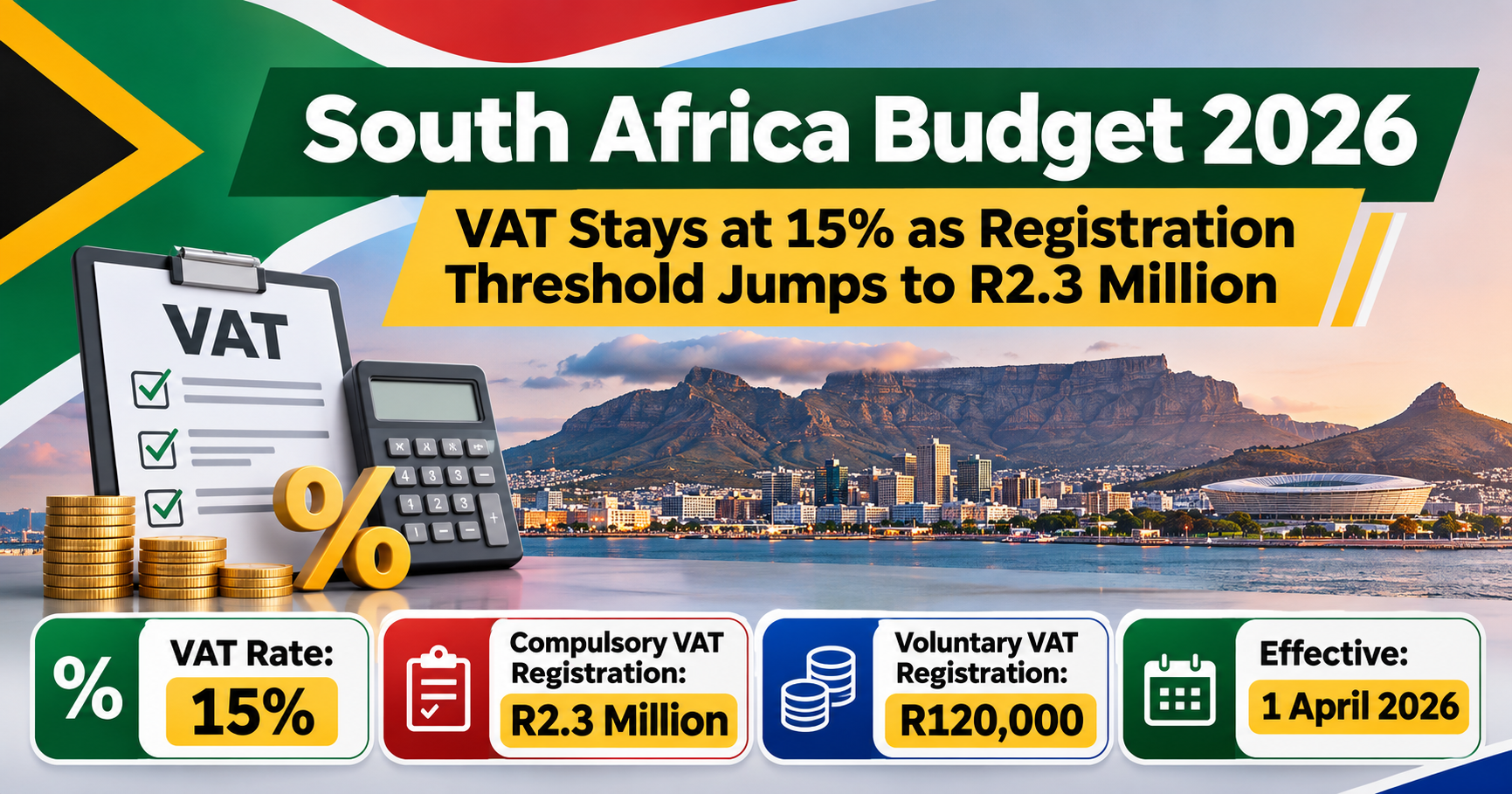
South Africa Budget 2026: VAT Stays at 15% as Registration Threshold Jumps to R2.3 Million
Published: November 12, 2026
Country: South Africa
Budget: National Budget 2026/27
Tax Authority: South African Revenue Service (SARS)
Budget Announcement: February 25, 2026
Threshold Effective Date: April 1, 2026
Standard VAT Rate: 15%
Introduction
South Africa's 2026 National Budget introduced significant Value-Added Tax (VAT) relief for small businesses while maintaining the standard VAT rate at 15%.
The Minister of Finance, Enoch Godongwana, announced that the compulsory VAT registration threshold would increase from R1 million to R2.3 million in annual taxable supplies.
The voluntary VAT registration threshold also increased from R50,000 to R120,000.
Both changes have been administered by SARS from April 1, 2026.
The increase is particularly important for small retailers, startups, consultants, freelancers, service providers and other growing enterprises.
Businesses that previously exceeded the R1 million threshold but remain below R2.3 million may no longer be required to maintain compulsory VAT registration based solely on turnover.
However, existing VAT registrations are not automatically cancelled.
Businesses must also distinguish between the new registration threshold, the 15% VAT rate, Turnover Tax for micro-businesses and the consequences of VAT deregistration.
This guide explains South Africa's 2026 VAT changes, registration requirements, exemptions, practical calculations, SARS eFiling procedures and compliance responsibilities.
1. What Changed in South Africa's Budget 2026?
The 2026 Budget introduced several measures to reduce small-business compliance costs.
The most important VAT changes are:
| VAT Rule | Before April 2026 | From April 1, 2026 |
|---|---|---|
| Standard VAT Rate | 15% | 15% |
| Compulsory Registration Threshold | R1,000,000 | R2,300,000 |
| General Voluntary Registration Threshold | R50,000 | R120,000 |
| Micro-Business Turnover Tax Limit | R1,000,000 | R2,300,000 |
The compulsory VAT threshold increased by 130%.
The VAT rate itself did not increase.
These changes are intended to reduce administrative pressure on smaller businesses and provide more room for growth.
2. Does South Africa Still Charge 15% VAT in 2026?
Yes.
South Africa continues to apply a standard VAT rate of 15% on qualifying standard-rated goods and services.
Earlier plans to increase the VAT rate to 15.5% and subsequently 16% were reversed.
The 2026 Budget retained the 15% standard rate.
VAT Example
A VAT-registered supplier sells standard-rated goods for R10,000 before VAT.
VAT at 15%:
R10,000 × 15% = R1,500.
Total invoice:
R10,000 + R1,500 = R11,500.
The business must account for relevant output VAT and may claim eligible input VAT according to the law.
3. What Is the New R2.3 Million VAT Registration Threshold?
From April 1, 2026, compulsory VAT registration generally arises where taxable supplies exceed R2.3 million in the relevant consecutive 12-month period.
Registration can also arise where a written contractual obligation establishes that taxable supplies will exceed the threshold during a relevant 12-month period.
Important
The threshold concerns the value of taxable supplies, not net profit.
Taxable supplies generally include standard-rated and zero-rated supplies.
Exempt supplies and transactions outside the relevant enterprise activities receive different treatment.
A business with R2 million in taxable sales and R100,000 in net profit is below the new general compulsory threshold, assuming no other registration trigger applies.
4. When Did the New Threshold Become Effective?
The Minister announced the change during the February 25, 2026 Budget Speech.
SARS began administering the new thresholds from April 1, 2026.
Its September 2026 VAT Connect guidance explained that the legislative amendments remained subject to promulgation and would apply retrospectively once enacted.
Therefore, businesses should distinguish between the administrative implementation date and the completion of the legislative process.
For practical registration applications, SARS is using the R2.3 million threshold.
5. Which Businesses Benefit From the Higher Threshold?
The reform can benefit businesses with annual taxable supplies between R1 million and R2.3 million.
Examples include:
- Small retail shops.
- Local service providers.
- Independent consultants.
- Freelance professionals.
- Repair businesses.
- Small online stores.
- Home-based enterprises.
- Certain hospitality businesses.
- Startups.
- Small trading businesses.
The new threshold may reduce registration and accounting obligations for businesses that are no longer required to register.
However, continuing voluntary registration may still be commercially beneficial.
6. Example: Business With Annual Sales of R900,000
Consider a small retailer making R900,000 in annual taxable supplies.
Previous compulsory threshold:
R1 million.
New compulsory threshold:
R2.3 million.
The business is below both thresholds.
Therefore, compulsory VAT registration does not ordinarily arise solely from these sales.
The business may qualify for voluntary registration if the relevant requirements are satisfied.
7. Example: Business With R1.8 Million Annual Sales
A small company makes taxable supplies of R1.8 million over 12 months.
Under the previous threshold of R1 million, it would generally have exceeded the compulsory registration limit.
Under the new R2.3 million threshold, its turnover is below the general compulsory limit.
Important
If the company is already registered as a VAT vendor, it must not simply stop charging VAT.
It should consider whether to remain voluntarily registered or apply for cancellation.
The company remains responsible for VAT until its registration is formally cancelled by SARS.
8. Example: Business With R2.5 Million Annual Sales
A trading company makes taxable supplies of R2.5 million during the relevant 12-month period.
The company exceeds the new R2.3 million threshold.
Compulsory registration generally applies.
The business should submit its registration application within the applicable timeframe and follow the VAT rules.
9. When Must a Business Register for VAT?
SARS generally requires an application for compulsory VAT registration within 21 business days after the relevant registration liability arises.
The date may be linked to exceeding the threshold or a qualifying contractual obligation.
Businesses should monitor taxable supplies regularly.
Practical Monitoring Method
Review taxable sales for each rolling 12-month period.
Do not check only the financial year ended or calendar year turnover.
A company may exceed the threshold during a period that does not match its financial reporting year.
10. What Is Voluntary VAT Registration?
Voluntary registration allows qualifying businesses below the compulsory threshold to register for VAT.
From April 1, 2026, the general minimum taxable-supplies threshold increased to R120,000.
The business must still satisfy the applicable registration conditions.
Certain categories of businesses may qualify under special rules even where the ordinary minimum is not yet reached.
Why Register Voluntarily?
Possible advantages include:
- Claiming eligible input tax.
- Trading with VAT-registered business customers.
- Improving tax administration readiness.
- Supporting business expansion.
- Managing VAT on qualifying business purchases.
Potential disadvantages include additional administration, periodic VAT returns and cash-flow responsibilities.
11. Is Voluntary VAT Registration Always Better?
No.
A business should compare the advantages and costs.
For example, a business selling primarily to VAT-registered companies may find voluntary registration commercially useful.
A small business selling mainly to private consumers may face pricing challenges if VAT must be added to standard-rated sales.
The business should also consider eligible input tax, accounting costs and transaction mix.
Registration should be based on the overall commercial and tax position.
12. Can an Existing VAT Vendor Deregister?
Yes, where the legal requirements are met.
A business that remains below the new compulsory threshold may be eligible to apply for VAT registration cancellation.
However, the cancellation is not automatic.
SARS must process the application and determine the effective cancellation date.
Example
A business is already VAT-registered.
Its taxable supplies for the relevant 12 months are R1.5 million.
The business may consider cancellation because it falls below the new R2.3 million compulsory threshold.
However, it should review the financial consequences before applying.
13. How to Apply for VAT Deregistration
SARS provides an application process for VAT cancellation.
The relevant form is generally VAT123e for cancellation of a person's VAT registration across their enterprises.
Step-by-Step Process
- Verify eligibility for cancellation.
- Calculate taxable supplies for the relevant period.
- Review expected future taxable turnover.
- Consider input-tax and asset consequences.
- Complete the appropriate SARS cancellation form.
- Submit through the prescribed SARS process.
- Respond to any requests for supporting documentation.
- Wait for SARS to confirm the cancellation date.
- Submit the final VAT return.
- Settle any outstanding VAT liabilities.
Businesses should not regard the submission of an application as immediate cancellation.
14. What Is Exit VAT?
Exit VAT is one of the most important risks when deregistering.
When a VAT registration is cancelled, the law can require VAT to be accounted for on certain enterprise assets still held by the business.
Examples may include:
- Trading stock.
- Machinery.
- Equipment.
- Business furniture.
- Certain property or rights used in the enterprise.
SARS generally applies a relevant valuation method involving the lower of cost or open-market value, subject to the applicable legislation.
Important
Not every asset is automatically subject to exit VAT.
For example, different rules can apply to assets for which input tax was not deductible.
The final VAT201 return must correctly reflect any deemed supply.
15. Can Exit VAT Be Paid in Instalments?
SARS guidance states that qualifying VAT liabilities on deregistration may be paid in six equal monthly instalments.
Businesses should confirm the specific arrangement with SARS.
An instalment arrangement does not mean that exit VAT is automatically waived.
16. What if a Business Failed to Register Under the Old Threshold?
The higher 2026 threshold does not necessarily erase historical non-compliance.
For example, a business may have exceeded the former R1 million compulsory threshold before April 1, 2026.
If it failed to register when legally required, SARS may still review the earlier period.
Potential consequences can include:
- Backdated VAT registration.
- Outstanding VAT.
- Interest.
- Penalties.
- Additional compliance requirements.
Businesses should assess historical periods separately from the new threshold.
Where appropriate, they may consider SARS voluntary disclosure procedures.
17. What Is Turnover Tax for Micro-Businesses?
Turnover Tax is a simplified tax regime for qualifying micro-businesses.
It is separate from VAT.
The annual turnover eligibility limit increased from R1 million to R2.3 million from April 1, 2026.
Turnover Tax Rates for 2026/27
| Annual Taxable Turnover | Tax Calculation |
|---|---|
| R0–R600,000 | 0% |
| R600,001–R950,000 | 1% of turnover above R600,000 |
| R950,001–R1,400,000 | R3,500 + 2% above R950,000 |
| Above R1,400,000 | R12,500 + 3% above R1,400,000 |
These rates apply only to eligible micro-businesses under the relevant Turnover Tax framework.
Professional-service and investment-income restrictions, ownership rules and other exclusions can affect eligibility.
18. Can a Business Be Registered for Both VAT and Turnover Tax?
Yes.
A qualifying business may be registered under the Turnover Tax system and also be VAT-registered.
These are separate systems.
Difference
VAT: Applies to qualifying taxable goods and services.
Turnover Tax: A simplified direct-tax regime calculated on relevant turnover for eligible micro-businesses.
Being registered for Turnover Tax does not automatically establish VAT registration or exemption.
19. Does the New Threshold Mean Businesses Pay No Tax?
No.
The VAT registration threshold only determines whether compulsory VAT registration is generally required.
A business below the threshold may still have obligations involving:
- Income tax.
- Corporate Income Tax.
- PAYE.
- UIF.
- Skills Development Levy.
- Turnover Tax where applicable.
- Other relevant taxes.
The threshold should not be described as a R2.3 million tax-free profit allowance.
20. South Africa's Zero-Rated and Exempt Supplies
Not all supplies are subject to 15% VAT.
Certain goods and services may be zero-rated.
Others may be exempt.
Zero-Rated Supplies
Where applicable, VAT is charged at 0%, and qualifying input tax may still be deductible.
Exempt Supplies
Exempt supplies generally do not attract output VAT, but the associated input-tax deduction position differs.
The distinction matters when calculating taxable turnover and deciding whether registration is required.
Businesses should use the current SARS guidance for their specific products and services.
21. VAT Calculation Example for a Registered Company
Assume a VAT-registered company makes standard-rated taxable sales worth R100,000 before VAT.
Output VAT:
R100,000 × 15% = R15,000.
The business also has qualifying purchases that generate R6,000 of deductible input VAT.
Illustrative net VAT:
R15,000 − R6,000 = R9,000.
| Description | Amount |
|---|---|
| Sales Before VAT | R100,000 |
| Output VAT | R15,000 |
| Eligible Input VAT | R6,000 |
| Illustrative Net VAT | R9,000 |
The final liability depends on actual invoice records, timing, exemptions and other applicable adjustments.
22. How to Register for VAT Through SARS
Step 1: Visit SARS
Open https://www.sars.gov.za/.
Step 2: Access eFiling
Sign in to the business's registered SARS eFiling account.
Step 3: Confirm Registration Information
Verify the taxpayer's business details.
Step 4: Review VAT Eligibility
Determine whether compulsory or voluntary registration applies.
Step 5: Prepare Supporting Records
These may include business registration documents, identification, banking information, trading activity and turnover records.
Step 6: Complete the VAT Registration Process
Submit the relevant electronic application or prescribed form.
Step 7: Respond to SARS Requests
Provide further supporting information if requested.
Step 8: Confirm Registration
Verify the registration status and effective date.
Step 9: Update Invoices and Accounting Systems
Apply VAT only according to the applicable vendor registration and tax rules.
Step 10: Begin VAT Return Compliance
Follow the assigned VAT tax periods and return requirements.
23. How to File a VAT201 Return
Registered vendors generally submit their VAT returns using the VAT201 declaration.
The process includes:
- Confirm the correct VAT reporting period.
- Reconcile sales and output VAT.
- Reconcile purchases and eligible input VAT.
- Review zero-rated and exempt transactions.
- Verify credit notes and adjustments.
- Complete the relevant VAT201 fields.
- Submit through SARS eFiling or another approved method.
- Pay any VAT due.
- Retain submission and payment confirmations.
Businesses should maintain proper records to support amounts declared.
24. What Is the VAT201 Filing Deadline?
The ordinary deadline depends on the filing and payment method.
General SARS Rules
For relevant non-eFiling submissions, the deadline is generally the 25th day of the month following the tax period, or the preceding business day where required.
For qualifying SARS eFiling submissions and payment methods, the deadline is generally the final business day of that following month.
Example
Suppose a business has a VAT period ending October 31, 2026.
The filing and payment deadline will depend on the method used.
A vendor should check the exact SARS return notice and payment channel.
Late payment can result in penalties and interest.
25. South Africa VAT and Online Businesses
Online stores and digital-service providers should review whether their activities fall within the VAT framework.
The new compulsory threshold can affect:
- E-commerce businesses.
- Online service providers.
- Software companies.
- Digital consultants.
- Subscription businesses.
- Relevant non-resident electronic-service suppliers.
Certain non-resident electronic-service suppliers have specific registration rules.
Foreign businesses should not assume they are exempt merely because they do not maintain a physical office in South Africa.
26. What About Freelancers and Consultants?
Freelancers may also need VAT registration when their qualifying taxable supplies exceed the relevant threshold.
Example
A consultant has annual taxable service revenue of R1.6 million.
The consultant is below the new general compulsory threshold.
However, voluntary registration may still be possible.
Separately, the consultant must review income tax obligations.
Important
A professional service business may not qualify for Turnover Tax because of restrictions on relevant professional-service receipts.
VAT eligibility and Turnover Tax eligibility must be evaluated independently.
27. Business Advantages of the 2026 VAT Reform
The increased threshold can provide several benefits.
Reduced Administrative Costs
Some businesses may no longer need compulsory VAT registration.
More Room for Growth
Companies can increase taxable turnover before crossing the new registration threshold.
Simplified Small-Business Planning
The new threshold provides additional flexibility for qualifying enterprises.
Improved Cash-Flow Planning
Businesses may be able to reassess VAT registration and pricing decisions.
Greater Access to Turnover Tax
The increased R2.3 million micro-business limit broadens potential eligibility, subject to the rules.
However, the overall benefit depends on the business's customers, eligible input tax and other circumstances.
28. Common South Africa VAT Mistakes to Avoid
- Assuming the VAT rate increased to 16%.
- Continuing to use the old R1 million compulsory threshold for new post-April 2026 registration decisions.
- Confusing the R2.3 million threshold with taxable profit.
- Ignoring the rolling 12-month turnover test.
- Treating every business below the threshold as automatically deregistered.
- Stopping VAT charges before SARS confirms cancellation.
- Ignoring exit VAT.
- Assuming old VAT registration failures are forgiven.
- Confusing VAT with Turnover Tax.
- Assuming all small businesses qualify for Turnover Tax.
- Ignoring zero-rated and exempt supply classifications.
- Missing the 21-business-day compulsory registration application requirement.
- Filing VAT201 late.
- Failing to maintain valid tax invoices.
- Ignoring the difference between non-electronic and eFiling payment deadlines.
- Assuming an overseas digital business can never be VAT-registered.
29. South Africa VAT Compliance Checklist for 2026
- Confirm the 15% VAT rate.
- Use the R2.3 million compulsory threshold.
- Check the R120,000 voluntary threshold.
- Review rolling 12-month taxable supplies.
- Consider relevant contractual obligations.
- Verify business registration status.
- Check existing VAT registration.
- Evaluate possible deregistration.
- Calculate any exit VAT.
- Review historical registration liabilities.
- Determine zero-rated and exempt supplies.
- Maintain tax invoice records.
- Reconcile input and output VAT.
- Submit VAT201 returns.
- Pay VAT by the correct deadline.
- Review Turnover Tax eligibility.
- Retain supporting documents.
- Follow SARS legislative and administrative updates.
30. Watch Tax With Naeem — Related Tax Education
For general tax education covering business income, salary income, rental income, capital gains, dividends and tax return filing, watch this related tutorial from Tax With Naeem.
Related Video: Income Tax Return Filing in Pakistan — Salary, Rental Income, Capital Gains and Dividends Explained
https://www.youtube.com/watch?v=VX88o1N1AfA
This is a Pakistan income tax tutorial, not a South African VAT registration or SARS eFiling tutorial.
It is included as supplementary educational content.
For South African VAT requirements, readers should follow official SARS guidance.
31. Official Government Sources and References
1. SARS — Budget 2026 Frequently Asked Questions
2. SARS — New VAT Registration Threshold
https://www.sars.gov.za/faq/what-is-the-new-threshold-for-vat-registration/
3. SARS — Register for VAT
https://www.sars.gov.za/types-of-tax/value-added-tax/register-for-vat/
4. SARS — VAT Overview
https://www.sars.gov.za/types-of-tax/value-added-tax/
5. SARS — VAT Vendor Obligations
https://www.sars.gov.za/types-of-tax/value-added-tax/obligations-of-a-vat-vendor/
6. SARS — VAT Connect, September 2026
7. SARS — VAT and Turnover Tax Examples
8. South African Government — Budget Speech 2026
https://www.gov.za/2026BudgetSpeech
9. National Treasury — Budget 2026
https://www.treasury.gov.za/documents/national%20budget/2026/
10. SARS — Official eFiling
https://www.sarsefiling.co.za/
11. AsaanTax.pk — International Tax Guides
12. Tax With Naeem — Related Tax Tutorial
https://www.youtube.com/watch?v=VX88o1N1AfA
32. Conclusion: What Does South Africa's VAT Reform Mean for Businesses?
South Africa's 2026 Budget provides meaningful tax administration relief for smaller enterprises.
The standard VAT rate remains unchanged at 15%.
However, from April 1, 2026, the compulsory VAT registration threshold increased from R1 million to R2.3 million.
The voluntary threshold also increased from R50,000 to R120,000.
These changes can reduce compliance costs and allow some smaller businesses to grow without becoming compulsorily VAT-registered.
Nevertheless, existing vendors must not assume automatic deregistration.
A business wishing to cancel VAT registration must follow SARS procedures and consider possible exit VAT, outstanding liabilities and input-tax consequences.
The higher threshold also does not remove income tax, payroll obligations or other statutory responsibilities.
The key takeaway is that South Africa kept VAT at 15% while substantially increasing the registration thresholds to support small businesses.
For more international tax guides covering South Africa, the UK, USA, Canada, Australia, UAE, Singapore and Pakistan, visit:
AsaanTax.pk: https://www.asaantax.pk/
Editorial Note: Prepared on November 12, 2026, using SARS and National Treasury's 2026 Budget publications. The new VAT thresholds are being administered by SARS from April 1, 2026. SARS's September 2026 guidance indicated that the related legislative amendments were still awaiting promulgation.
Disclaimer: This article is for general educational purposes and is not individualized South African tax or legal advice. Actual registration, deregistration and VAT liabilities depend on taxable supplies, transaction classification, timing, tax periods and applicable legislation. Businesses should consult SARS or a qualified South African tax adviser before making major compliance decisions.