UAE Corporate Tax 2026: 9% Rate, AED 375,000 Threshold and Small Business Relief — Complete Guide
Published: November 10, 2026
Jurisdiction: United Arab Emirates (UAE)
Applicable Legislation: Federal Decree-Law No. 47 of 2022, as amended
Major Update: Small Business Relief extended to December 31, 2029
The United Arab Emirates has introduced a modern corporate taxation system that applies to many businesses operating in Dubai, Abu Dhabi, Sharjah and other emirates.
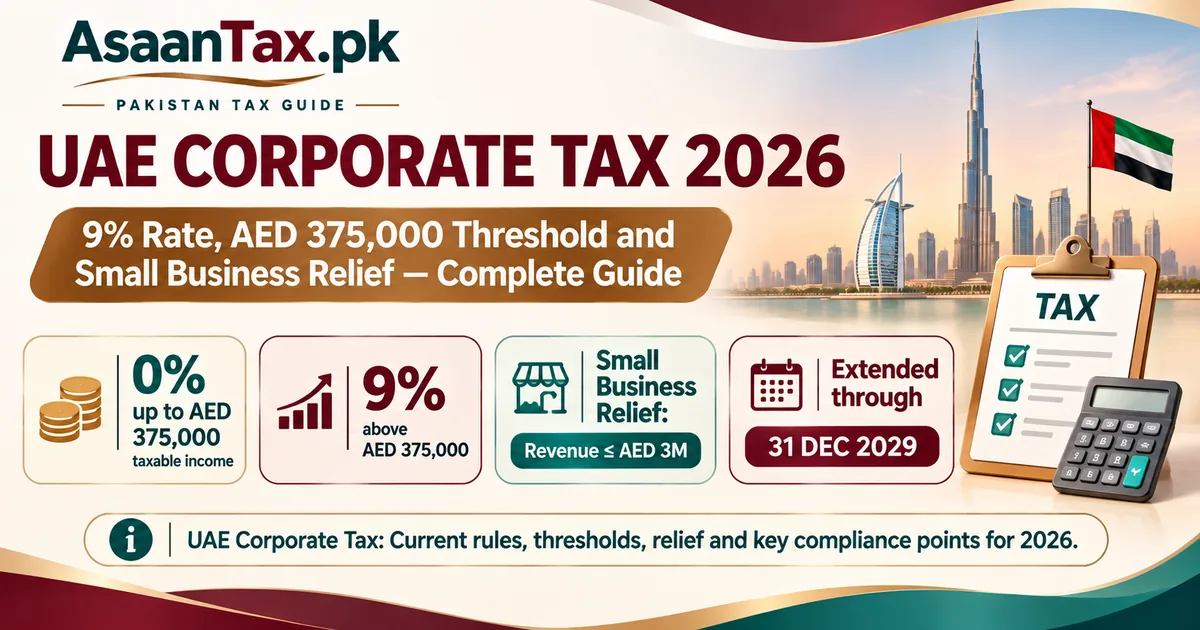
Under the standard UAE Corporate Tax regime, taxable income up to AED 375,000 is subject to a 0% rate, while taxable income exceeding AED 375,000 is generally subject to 9% Corporate Tax.
The UAE also provides Small Business Relief for eligible resident businesses with annual revenue not exceeding AED 3 million, subject to specified conditions.
Important 2026 Update: On August 7, 2026, the UAE Ministry of Finance announced an extension of Small Business Relief through tax periods ending on or before December 31, 2029. The previous December 2026 expiry date is no longer current.
This guide explains Corporate Tax rates, eligible businesses, Small Business Relief, free-zone exemptions, registration requirements, accounting records, tax calculations, filing deadlines and important compliance obligations.
1. What Is UAE Corporate Tax?
UAE Corporate Tax is a federal tax on the taxable profits of businesses and other taxable persons within the scope of the Corporate Tax Law.
The legal framework was established through Federal Decree-Law No. 47 of 2022 on the Taxation of Corporations and Businesses.
The tax generally applies to financial years beginning on or after June 1, 2023.
Unlike Value Added Tax (VAT), Corporate Tax is primarily calculated using taxable income rather than the total value of sales.
Corporate Tax and VAT are separate obligations with different registration requirements, filing procedures and tax calculations.
2. UAE Corporate Tax Rates in 2026
Under the standard Corporate Tax regime, the general rates are:
| Taxable Income | Corporate Tax Rate |
|---|---|
| First AED 375,000 | 0% |
| Amount exceeding AED 375,000 | 9% |
The 9% rate does not normally apply to the entire taxable income once the AED 375,000 threshold is crossed.
Instead, it applies to the portion exceeding that threshold.
UAE Corporate Tax Formula
Corporate Tax = (Taxable Income − AED 375,000) × 9%
This simplified formula applies where taxable income exceeds AED 375,000 and the business is subject to the standard rates, before considering relevant adjustments or credits.
Example 1: Taxable Income of AED 300,000
Taxable income: AED 300,000
The amount falls within the standard 0% band.
Corporate Tax: AED 0
The business may still have registration, filing and record-keeping obligations.
Example 2: Taxable Income of AED 600,000
Taxable income: AED 600,000
Amount above AED 375,000:
AED 600,000 − AED 375,000 = AED 225,000
Corporate Tax:
AED 225,000 × 9% = AED 20,250
Corporate Tax payable: AED 20,250, before any applicable tax credits or adjustments.
Example 3: Taxable Income of AED 1 Million
Taxable income: AED 1,000,000
Taxable amount above the threshold:
AED 1,000,000 − AED 375,000 = AED 625,000
Corporate Tax:
AED 625,000 × 9% = AED 56,250
Corporate Tax payable: AED 56,250, before applicable credits.
3. UAE Corporate Tax Calculation Table
| Annual Taxable Income | Standard Corporate Tax |
|---|---|
| AED 200,000 | AED 0 |
| AED 375,000 | AED 0 |
| AED 500,000 | AED 11,250 |
| AED 750,000 | AED 33,750 |
| AED 1,000,000 | AED 56,250 |
| AED 1,500,000 | AED 101,250 |
| AED 2,000,000 | AED 146,250 |
| AED 3,000,000 | AED 236,250 |
These figures assume standard Corporate Tax treatment and taxable income equal to the listed amounts.
They do not represent tax payable where Small Business Relief, qualifying free-zone treatment, exemptions, carried-forward losses or other provisions apply.
4. Is the AED 375,000 Corporate Tax Threshold Based on Revenue or Profit?
The AED 375,000 standard 0% threshold concerns taxable income, not business revenue.
This distinction is extremely important.
Revenue is the income generated from business activities before deducting relevant expenses.
Taxable income is generally determined from accounting income after applying adjustments required by the Corporate Tax Law.
Example
A Dubai company has:
- Annual revenue: AED 2,000,000.
- Accounting expenses: AED 1,500,000.
- Accounting profit: AED 500,000.
Assuming its taxable income is also AED 500,000, the standard Corporate Tax calculation is:
AED 500,000 − AED 375,000 = AED 125,000
AED 125,000 × 9% = AED 11,250
The standard Corporate Tax would be AED 11,250.
However, this company might separately qualify for Small Business Relief because its revenue does not exceed AED 3 million, provided all eligibility conditions are met.
5. What Is UAE Small Business Relief?
Small Business Relief is a special provision designed to reduce the Corporate Tax compliance burden on eligible small businesses.
Article 21 of the UAE Corporate Tax Law permits qualifying resident taxable persons to elect for relief, subject to the applicable ministerial decisions.
An eligible business that makes a valid election is treated as not having derived taxable income for the relevant tax period.
This can eliminate its Corporate Tax liability for that period.
However, the relief is not automatic.
Businesses must satisfy the eligibility conditions and make the required election through the Corporate Tax return.
6. Small Business Relief Extended to December 31, 2029
The UAE Ministry of Finance announced a significant extension of Small Business Relief on August 7, 2026.
Ministerial Decision No. 131 of 2026 amended the previous relief framework.
Updated Relief Conditions
| Requirement | Rule |
|---|---|
| Annual revenue threshold | AED 3,000,000 or less |
| Taxpayer status | Eligible UAE Resident Person |
| Previous tax periods | Revenue must also satisfy the threshold |
| Valid election | Required for each relevant tax period |
| Relief availability | Tax periods ending on or before December 31, 2029 |
| Qualifying Free Zone Persons | Not eligible |
| Certain large multinational groups | Not eligible |
The original relief framework was scheduled to end on December 31, 2026.
That date has been superseded by the 2026 extension to December 31, 2029.
Businesses should use the updated Ministerial Decision rather than older guidance showing the previous deadline.
7. Who Is Eligible for Small Business Relief?
Eligible UAE resident taxable persons may claim Small Business Relief where they satisfy the statutory conditions.
These may include:
- Mainland limited liability companies.
- Eligible resident small businesses.
- Certain resident sole proprietors within the Corporate Tax scope.
- Eligible consulting businesses.
- Eligible trading companies.
- Small service providers.
- Other qualifying resident persons.
Key Eligibility Rules
Revenue must not exceed AED 3 million.
The business must meet the threshold in the relevant tax period and all previous relevant tax periods.
The taxpayer must be eligible as a Resident Person.
The relevant residency and Corporate Tax rules must be satisfied.
The taxpayer must not be a Qualifying Free Zone Person.
Qualifying Free Zone Persons are specifically excluded from Small Business Relief.
The taxpayer must not belong to an excluded large multinational group.
The relevant multinational group exclusion must be considered.
A valid election is required.
The taxpayer must elect to use Small Business Relief for the applicable period through its Corporate Tax return.
8. What Happens if Revenue Exceeds AED 3 Million?
The revenue threshold is critical.
Under the relief framework, a taxable person cannot elect for Small Business Relief if revenue exceeds AED 3 million in the relevant or a previous tax period covered by the applicable rules.
Example
A company records the following revenue:
| Tax Period | Annual Revenue |
|---|---|
| 2024 | AED 2,100,000 |
| 2025 | AED 2,700,000 |
| 2026 | AED 3,200,000 |
Because the company's revenue exceeded AED 3 million in 2026, it cannot claim Small Business Relief for that period.
It should also consider the impact of this breach on future eligibility under the applicable conditions.
Important: Businesses should not assume that falling back below AED 3 million automatically restores eligibility.
9. Example: Small Business Relief Can Reduce Corporate Tax to Zero
Suppose a small Dubai trading company has:
- Annual revenue: AED 2,500,000.
- Allowable business expenses: AED 1,700,000.
- Taxable income before relief: AED 800,000.
Without Small Business Relief, its simplified standard tax calculation would be:
AED 800,000 − AED 375,000 = AED 425,000
AED 425,000 × 9% = AED 38,250
If the company qualifies for Small Business Relief and makes a valid election, it is treated as having no taxable income for that tax period.
Corporate Tax after valid Small Business Relief election: AED 0.
The company must still comply with the applicable filing and record-keeping requirements.
10. Does a Business With AED 3 Million Revenue Automatically Pay Zero Tax?
No.
Revenue eligibility alone does not guarantee Small Business Relief.
The taxpayer must satisfy all statutory conditions and elect for relief.
A business with AED 2 million revenue may fail to qualify because it is an excluded Qualifying Free Zone Person or previously exceeded the applicable revenue threshold.
A qualifying business may also lose the opportunity to claim relief if it fails to make the appropriate election when required.
Therefore, businesses should verify eligibility before preparing the Corporate Tax return.
11. Does Small Business Relief Eliminate the Need to File a Tax Return?
No.
Eligible taxable persons generally still need to register and submit the required Corporate Tax return, even when Small Business Relief results in zero taxable income.
The Federal Tax Authority reiterated this requirement in its September 2026 compliance announcements.
The Small Business Relief election is made through the relevant return.
A business should not simply stop filing because its revenue is below AED 3 million.
12. Can Businesses Claim Tax Losses While Using Small Business Relief?
Small Business Relief has consequences for tax losses and certain other deductions.
A taxable person electing Small Business Relief generally cannot carry forward tax losses arising during the relief period.
Similarly, certain unused net interest expenditure amounts relating to that period cannot be carried forward.
Previous qualifying tax losses from periods without a Small Business Relief election may remain available for later periods where the business does not elect the relief, subject to the relevant conditions.
This is one reason that eligible businesses should consider their tax position before making the election.
13. UAE Corporate Tax for Free Zone Companies in 2026
A company established in a UAE Free Zone is not automatically exempt from Corporate Tax.
Qualifying Free Zone Persons may benefit from a special regime.
Under this regime:
- Qualifying Income may be subject to 0% Corporate Tax.
- Taxable Income that is not Qualifying Income may be subject to 9% Corporate Tax.
- Additional eligibility and compliance conditions apply.
Important Conditions
A Qualifying Free Zone Person must satisfy the applicable requirements relating to qualifying income, substance, transfer pricing, audited financial statements and other relevant provisions.
The special free-zone regime also includes restrictions and de minimis rules.
Important: A Qualifying Free Zone Person does not receive the ordinary AED 375,000 zero-rate band on its non-qualifying taxable income.
A free-zone company that does not qualify for the special regime may instead be subject to the ordinary Corporate Tax rules.
14. Is Corporate Tax Applicable to Freelancers in the UAE?
Natural persons conducting a business or business activity in the UAE may be subject to Corporate Tax where their total business turnover exceeds AED 1 million during a Gregorian calendar year.
The applicable rule is different from the AED 375,000 taxable income threshold for calculating the standard tax rate.
Example
A resident individual conducts consulting activities in Dubai.
Annual business turnover is AED 1,200,000.
Because turnover exceeds AED 1 million, the individual may fall within Corporate Tax registration and compliance requirements.
The person's taxable income must then be determined according to the law.
Where eligible, Small Business Relief may also be relevant.
Income Generally Outside This Natural Person Business Scope
The FTA identifies categories such as:
- Employment wages.
- Personal investment income.
- Qualifying personal real estate investment income.
These categories are subject to their own definitions and conditions.
15. Are Salaries Taxable Under UAE Corporate Tax?
Ordinary salary income earned by individuals is generally not subject to UAE Corporate Tax merely because the individual is employed.
The UAE Corporate Tax system primarily addresses business and relevant taxable activities.
However, a person who independently operates a licensed business or qualifying professional activity may have separate Corporate Tax obligations.
Salary income should not be confused with income earned from conducting a business.
16. UAE Corporate Tax Registration Through EmaraTax
Businesses subject to Corporate Tax registration requirements should register with the Federal Tax Authority through EmaraTax.
Official portal:
General Registration Steps
- Access the official EmaraTax portal.
- Create or access the relevant user account.
- Select the Corporate Tax registration service.
- Enter the business's legal and registration information.
- Provide the trade licence and other required documents.
- Identify the relevant taxable person details.
- Review ownership and authorized signatory information.
- Submit the application.
- Monitor the application status.
- Obtain the Corporate Tax Tax Registration Number (TRN), where applicable.
The exact registration deadline depends on the taxpayer category, establishment date and applicable FTA decisions.
Businesses should not assume that every entity has the same registration deadline.
17. UAE Corporate Tax Return Filing Deadline
For most taxpayers, the Corporate Tax return must be filed within nine months from the end of the relevant tax period.
Corporate Tax payable is generally due within the same statutory period.
Examples
| Financial Year-End | Standard Return and Payment Deadline |
|---|---|
| 31 December 2025 | 30 September 2026 |
| 31 March 2026 | 31 December 2026 |
| 30 June 2026 | 31 March 2027 |
| 31 December 2026 | 30 September 2027 |
These examples assume the ordinary nine-month filing rule and that no special rule applies.
Important
A business with zero Corporate Tax payable may still have a filing obligation.
Similarly, a business claiming Small Business Relief generally must file the applicable simplified return.
18. How to File a UAE Corporate Tax Return Online
The normal filing process is completed through EmaraTax.
Step 1: Log In
Access the official EmaraTax portal.
Step 2: Select the Registered Taxable Person
Choose the correct taxpayer and Corporate Tax registration.
Step 3: Open the Corporate Tax Return
Select the relevant tax period.
Step 4: Review Financial Information
Prepare accounting revenue, expenses, net profit and required adjustments.
Step 5: Calculate Taxable Income
Apply the relevant Corporate Tax provisions and statutory adjustments.
Step 6: Review Relief and Exemption Eligibility
Confirm whether the business qualifies for Small Business Relief or another applicable provision.
Step 7: Complete the Return
Enter the required details and review the declaration.
Step 8: Submit the Return
Electronically submit the completed return.
Step 9: Pay Corporate Tax
If Corporate Tax is payable, complete payment within the applicable deadline.
Step 10: Retain Filing Evidence
Save the official acknowledgment and supporting tax records.
19. What Expenses Are Deductible for UAE Corporate Tax?
Business expenditure may be deductible where it satisfies the applicable Corporate Tax provisions.
Examples may include:
- Employee salaries.
- Office rent.
- Utilities.
- Business software and subscriptions.
- Professional fees.
- Marketing expenses.
- Eligible business travel expenses.
- Other legitimate business operating costs.
However, an expense is not automatically deductible simply because a business paid it.
The relevant rules on business purpose, capital expenditure, disallowed expenses, entertainment, interest and related-party transactions must be considered.
Personal expenses should not be treated as ordinary business deductions.
20. Corporate Tax Losses in the UAE
The UAE Corporate Tax Law permits qualifying tax losses to be carried forward, subject to conditions.
In general, the amount of carried-forward tax losses used in a later period may be limited to 75% of that period's taxable income.
Other conditions may affect loss utilization, including ownership and continuity requirements.
Businesses electing Small Business Relief should pay particular attention to the restrictions on losses arising during the relief period.
21. Corporate Tax vs VAT in the UAE
Corporate Tax and VAT are separate taxes.
| Feature | Corporate Tax | VAT |
|---|---|---|
| Standard Rate | 9% above AED 375,000 taxable income | 5% on standard-rated taxable supplies |
| Main Basis | Taxable profits | Taxable supplies and imports |
| Standard 0% Threshold | AED 375,000 taxable income | Not applicable in the same way |
| Registration | Corporate Tax rules | VAT registration rules |
| Main Portal | EmaraTax | EmaraTax |
The AED 375,000 figure is also used as the UAE's mandatory VAT registration threshold, but that threshold relates to taxable supplies and imports, not Corporate Tax profits.
Businesses should not confuse these two separate thresholds.
22. Does the UAE Have a 15% Corporate Tax Rate for Large Multinational Groups?
The UAE introduced a Domestic Minimum Top-up Tax effective for financial years beginning on or after January 1, 2025.
The rules primarily concern large multinational enterprise groups with global consolidated revenue of at least EUR 750 million in at least two of the preceding four financial years.
The framework is aligned with international Pillar Two minimum-tax rules.
The 15% minimum effective tax framework does not automatically apply to an ordinary small business or local company simply because it has profitable operations.
Businesses within large multinational groups should consider the additional rules and reporting requirements.
23. UAE Corporate Tax Records: What Documents Should Businesses Maintain?
The Federal Tax Authority generally requires relevant Corporate Tax records to be retained for at least seven years after the end of the relevant tax period.
Records may include:
- Financial statements.
- Sales invoices.
- Purchase invoices.
- Bank statements.
- Accounting ledgers.
- Payroll records.
- Asset and depreciation records.
- Relevant contracts.
- Supporting tax calculations.
- Related-party documentation.
- Previous Corporate Tax returns.
- Records supporting Small Business Relief eligibility.
Good record-keeping helps businesses substantiate taxable income, revenue thresholds and relief claims.
24. Common UAE Corporate Tax Mistakes
Businesses should avoid the following errors:
- Applying 9% to total revenue rather than taxable income.
- Treating the AED 375,000 threshold as an annual sales threshold.
- Assuming all Free Zone companies are automatically tax-free.
- Claiming Small Business Relief without making the required election.
- Ignoring revenue from previous relevant tax periods.
- Using the outdated 2026 Small Business Relief expiry date.
- Assuming zero tax means no return filing is required.
- Confusing the AED 1 million natural-person business turnover threshold with the AED 3 million Small Business Relief threshold.
- Reporting personal expenses as business deductions.
- Failing to retain accounting documentation.
- Missing registration deadlines.
- Missing return submission or payment deadlines.
- Overlooking the different rules for multinational enterprise groups.
- Failing to account for applicable related-party and transfer-pricing requirements.
25. UAE Corporate Tax Compliance Checklist for 2026
Before filing a UAE Corporate Tax return, review these items:
- Confirm whether the business is subject to Corporate Tax.
- Verify the correct tax period.
- Check Corporate Tax registration status.
- Prepare financial statements.
- Calculate accounting profit.
- Identify required tax adjustments.
- Confirm taxable income.
- Review the AED 375,000 standard zero-rate band.
- Check Small Business Relief eligibility.
- Verify the AED 3 million revenue threshold for all relevant periods.
- Confirm the latest relief expiry date of December 31, 2029.
- Consider Free Zone requirements, where applicable.
- Review deductible and non-deductible expenses.
- Check available tax loss relief.
- Submit the Corporate Tax return through EmaraTax.
- Pay any Corporate Tax due.
- Retain supporting records.
26. Tax With Naeem — Related Tax Education Video
For general tax education, income reporting and return filing concepts, you can also watch the Tax With Naeem YouTube channel.
Related Video: Income Tax Return Filing in Pakistan — Salary, Rental Income, Capital Gains and Dividends Explained
https://www.youtube.com/watch?v=VX88o1N1AfA
Important: This is a Pakistan income tax filing tutorial, not a UAE Corporate Tax tutorial. The laws and tax authorities are different. For UAE registration, calculations and filing, readers should follow official UAE Ministry of Finance and Federal Tax Authority guidance.
27. Official Sources and References
1. UAE Ministry of Finance — Small Business Relief Extension (August 7, 2026)
2. UAE Federal Tax Authority — Corporate Tax
https://tax.gov.ae/en/taxes/corporate.tax/corporate.tax.topics.aspx
3. UAE Federal Tax Authority — Corporate Tax Guides
https://www.tax.gov.ae/en/taxes/corporate.tax/corporate.tax.guides.references.aspx
4. UAE Ministry of Finance — Financial Legislation
https://mof.gov.ae/en/financial-legislation/
5. UAE Federal Tax Authority — Official Portal
6. EmaraTax — Registration and Filing
7. UAE Ministry of Finance — Domestic Minimum Top-up Tax
https://mof.gov.ae/en/public-finance/tax/top-up-tax/
8. AsaanTax.pk — Tax Guides
28. Conclusion: How Much UAE Corporate Tax Will Your Business Pay in 2026?
The UAE's standard Corporate Tax rate remains 0% on the first AED 375,000 of taxable income and 9% on taxable income exceeding that amount.
However, eligible resident businesses with annual revenue of AED 3 million or less may elect Small Business Relief.
The August 2026 amendment extended the relief to tax periods ending on or before December 31, 2029, giving qualifying businesses additional time to benefit.
The correct Corporate Tax outcome depends on taxable income, revenue history, the business's legal structure, Free Zone status, available relief and compliance with filing requirements.
The most important distinction is that AED 375,000 is a taxable income threshold, while AED 3 million is a revenue threshold for Small Business Relief.
Even a business with zero Corporate Tax payable may still need to register, file returns and maintain proper records.
For more guides covering business taxation, FBR rules, international taxation and tax compliance, visit AsaanTax.pk.
Editorial Note: This article reflects UAE Corporate Tax information available as of November 10, 2026, including Ministerial Decision No. 131 of 2026 extending Small Business Relief through December 31, 2029.
Disclaimer: This article provides general educational information. UAE Corporate Tax obligations depend on the taxpayer's legal status, residency, income classification, Free Zone status, accounting records and applicable legislation. Readers should consult UAE Federal Tax Authority guidance or a qualified UAE tax adviser for specific situations.