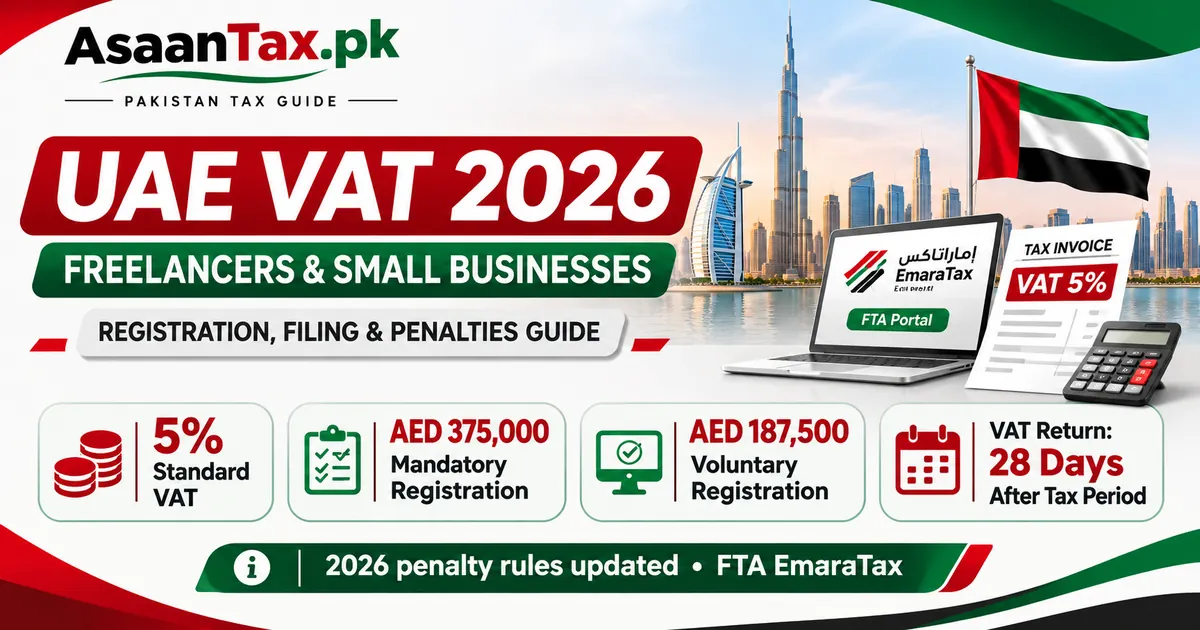
UAE VAT 5% for Freelancers and Small Businesses: Registration, Filing and Penalties in 2026
Published: November 10, 2026
Country: United Arab Emirates
Tax: Value Added Tax (VAT)
Standard VAT Rate: 5%
Tax Authority: Federal Tax Authority (FTA)
Latest Penalty Framework: Effective April 14, 2026
The United Arab Emirates is a major destination for entrepreneurs, freelancers, consultants, online businesses and international service providers. However, operating a small business in Dubai, Abu Dhabi, Sharjah or another emirate may create Value Added Tax (VAT) obligations.
The UAE applies a standard VAT rate of 5% to most taxable goods and services.
For UAE-resident businesses, VAT registration generally becomes mandatory when the value of relevant taxable supplies and imports exceeds AED 375,000 over the previous 12 months, or is expected to exceed that amount within the next 30 days.
Voluntary registration may be available when the relevant taxable supplies, imports or qualifying expenses exceed AED 187,500, subject to the applicable conditions.
Freelancers should pay particular attention to these rules because VAT registration depends on the nature and value of their business activities—not merely whether they operate a limited liability company.
This guide explains UAE VAT registration, freelancer obligations, exported services, input tax recovery, VAT return filing, late-payment penalties and the important administrative penalty changes effective from April 14, 2026.
1. What Is VAT in the UAE?
Value Added Tax is an indirect tax generally charged on taxable supplies of goods and services.
The UAE introduced VAT on January 1, 2018, under Federal Decree-Law No. 8 of 2017.
The standard VAT rate is 5%.
A VAT-registered business generally collects VAT from customers on standard-rated supplies and may recover eligible VAT paid on business purchases.
The amount payable to the Federal Tax Authority is generally calculated after considering output tax, recoverable input tax and applicable adjustments.
UAE VAT Overview for 2026
| VAT Requirement | General Rule |
|---|---|
| Standard VAT Rate | 5% |
| Mandatory Registration Threshold | AED 375,000 |
| Voluntary Registration Threshold | AED 187,500 |
| Standard Return Deadline | 28 days after tax period |
| Tax Authority | Federal Tax Authority |
| Registration Portal | EmaraTax |
| Common Tax Periods | Monthly or quarterly, as assigned |
| Latest Administrative Penalty Changes | Effective April 14, 2026 |
These rules must be applied according to the business's registration status and the nature of its supplies.
2. Do Freelancers Have to Register for UAE VAT?
Yes, freelancers can be required to register for VAT.
A freelancer conducting an independent economic activity may qualify as a taxable person under UAE VAT legislation.
The business does not necessarily need to be incorporated as a company for VAT registration obligations to arise.
Examples of potentially relevant freelance activities include:
- Software development.
- Website development.
- Graphic design.
- Digital marketing.
- Content writing.
- Photography and videography.
- Business consulting.
- IT support.
- Professional training.
- Social media management.
- Other independent commercial services.
Example
A freelance software developer based in Dubai earns AED 420,000 from relevant taxable services over the previous 12 months.
If the amount satisfies the mandatory threshold conditions, VAT registration will generally be required.
However, the VAT treatment of individual invoices depends on factors such as the place of supply, customer location and whether the service qualifies for zero-rating.
3. UAE VAT Mandatory Registration Threshold — AED 375,000
Under the Federal Tax Authority's registration guidance, VAT registration is mandatory for UAE-resident businesses when the value of relevant taxable supplies and imports exceeds AED 375,000 over the previous 12 months.
Registration is also required where the business expects to exceed the threshold within the next 30 days.
The threshold is based on relevant taxable supplies and imports, not net business profit.
Example: Small Business With AED 400,000 Revenue
Assume a consulting business has:
| Description | Amount |
|---|---|
| Annual Relevant Taxable Supplies | AED 400,000 |
| Business Expenses | AED 180,000 |
| Accounting Profit | AED 220,000 |
Although the accounting profit is AED 220,000, relevant taxable supplies exceed AED 375,000.
The business would generally need to register for VAT, assuming the statutory conditions are met.
Does Zero-Rated Revenue Count Toward Registration?
Zero-rated supplies generally remain taxable supplies for the purpose of assessing the registration threshold.
This is particularly relevant for freelancers supplying qualifying services to overseas customers.
The fact that a service may be zero-rated does not automatically remove its value from the threshold calculation.
4. Voluntary VAT Registration — AED 187,500
Businesses not meeting mandatory registration conditions may still be eligible to register voluntarily.
The voluntary registration threshold is AED 187,500.
The test may consider relevant taxable supplies, imports or taxable business expenses over the previous 12 months, or amounts expected during the next 30 days.
Example
A small marketing agency earns AED 250,000 in relevant taxable revenue.
Although it does not exceed the AED 375,000 mandatory registration threshold, it may qualify for voluntary registration.
Benefits of Voluntary Registration
Potential benefits include:
- Recovery of eligible input VAT.
- Improved VAT documentation.
- Ability to issue compliant tax invoices after registration.
- More structured accounting records.
- Preparation for future business growth.
Responsibilities of Voluntary Registration
Once registered, the business also assumes VAT compliance duties, including:
- Submitting VAT returns.
- Issuing required tax invoices.
- Maintaining supporting records.
- Accounting for relevant VAT.
- Meeting payment deadlines.
- Monitoring changes affecting its registration.
Voluntary registration should therefore be considered carefully rather than treated as an automatic financial benefit.
5. How to Calculate 5% UAE VAT
For standard-rated supplies, the basic calculation is:
VAT = Taxable Value × 5%
Example: Freelance Design Project
A UAE freelancer provides a standard-rated design service for AED 10,000, excluding VAT.
VAT calculation:
AED 10,000 × 5% = AED 500
Total invoice:
AED 10,000 + AED 500 = AED 10,500
| Description | Amount |
|---|---|
| Service Value | AED 10,000 |
| VAT at 5% | AED 500 |
| Total Invoice | AED 10,500 |
This example assumes the freelancer is VAT-registered and the service is subject to the standard 5% rate.
VAT-Inclusive Price Calculation
If an agreed total price already includes 5% VAT:
VAT = VAT-Inclusive Price × 5 ÷ 105
For an invoice total of AED 10,500:
VAT = AED 500
Net value = AED 10,000
Businesses must distinguish VAT-inclusive and VAT-exclusive pricing to avoid incorrect invoicing.
6. Is UAE VAT Charged on Freelance Services Provided to Foreign Clients?
Some services supplied to overseas clients may qualify for zero-rated VAT.
However, an overseas client does not automatically make every service zero-rated.
The UAE VAT legislation and Executive Regulation contain specific requirements for exported services.
The treatment may depend on:
- Where the customer is established.
- Whether the recipient is outside the UAE.
- Whether the recipient has a relevant UAE presence.
- The nature of the service.
- Whether the service is directly connected with UAE real estate.
- Whether specific performance, location or other exceptions apply.
Example
A Dubai-based freelance designer provides eligible digital design services to a business established outside the UAE.
If the export-of-services requirements are satisfied, the supply may qualify for 0% VAT.
This means the relevant invoice could be zero-rated rather than subject to the standard 5% rate.
However, the revenue may still count as a taxable supply for registration threshold purposes.
Important
A 0% VAT supply is different from an exempt supply.
Zero-rated and exempt transactions can have different implications for input tax recovery and registration requirements.
7. What If a Freelancer Has Only Zero-Rated Sales?
A business making exclusively zero-rated supplies may, in certain circumstances, apply for an exception from VAT registration.
This is different from assuming that registration is automatically unnecessary.
The Federal Tax Authority's guidance outlines conditions for requesting an exception where the person makes only zero-rated supplies and does not have relevant imports subject to the reverse-charge mechanism.
The taxpayer should obtain the applicable FTA decision before relying on registration exception treatment.
8. UAE VAT Registration for Small Businesses and Online Stores
VAT registration rules can apply to many types of small businesses.
Examples include:
- E-commerce stores.
- Local retailers.
- Cleaning companies.
- Restaurants and cafés.
- Marketing agencies.
- Repair businesses.
- IT consultancies.
- Professional service providers.
- Importers and distributors.
A small business should monitor its relevant taxable turnover using a rolling 12-month calculation.
Example
An online store records relevant taxable supplies of:
| Period | Amount |
|---|---|
| First 3 months | AED 90,000 |
| Next 3 months | AED 110,000 |
| Next 3 months | AED 100,000 |
| Final 3 months | AED 95,000 |
| Total | AED 395,000 |
Total relevant supplies are AED 395,000.
Assuming the mandatory registration conditions are met, the business should have applied for VAT registration within the prescribed period after becoming required to register.
Businesses should not wait until the end of the calendar year to evaluate registration eligibility.
9. When Must a Business Apply for VAT Registration?
A person required to register for VAT generally must submit the VAT registration application within 30 days of becoming required to register.
This is a separate requirement from the test that considers expected taxable supplies during the next 30 days.
Businesses should monitor the threshold continuously.
Example
If relevant taxable supplies exceed AED 375,000 during a rolling 12-month period, the business should determine the date the registration obligation arose and calculate its application deadline accordingly.
Failure to register on time can result in penalties and potential VAT liabilities for periods when the business should have been registered.
10. How to Register for UAE VAT Through EmaraTax
The Federal Tax Authority provides online VAT registration through EmaraTax.
Official Portal: https://eservices.tax.gov.ae/
Step 1: Create an EmaraTax Account
Visit the official portal and access the available authentication process.
Step 2: Create a Taxable Person Profile
Enter the business or individual's relevant identification and registration details.
Step 3: Select VAT Registration
Open the Value Added Tax registration service.
Step 4: Provide Business Information
Enter the business's legal name, activity, trade licence details where applicable and other required information.
Step 5: Provide Financial Details
Complete the relevant turnover and expected taxable supplies information.
Step 6: Upload Supporting Documents
The documents may include:
- Trade licence, where applicable.
- Emirates ID or other identification documents.
- Passport details where required.
- Business ownership documents.
- Financial statements or revenue records.
- Sales invoices.
- Relevant contracts.
- Other supporting documents requested by the FTA.
Step 7: Review the Application
Check the accuracy of all declarations.
Step 8: Submit the Application
Submit through EmaraTax.
Step 9: Monitor the Application
Respond to any request for further information.
Step 10: Obtain the Tax Registration Number
After approval, download the registration certificate and verify the effective registration date.
Do not charge VAT as a registered taxable person before confirming the relevant legal authorization and effective registration treatment.
11. How Often Must UAE VAT Returns Be Filed?
VAT-registered taxpayers generally file returns according to the tax periods assigned by the Federal Tax Authority.
Common tax periods are monthly or quarterly.
The exact tax period is shown in the taxpayer's EmaraTax records.
VAT Filing Deadline
The normal deadline is 28 days after the end of the tax period.
For example:
| Example Tax Period | Ordinary Filing Deadline |
|---|---|
| July–September 2026 | October 28, 2026 |
| October–December 2026 | January 28, 2027 |
| November 2026 monthly period | December 28, 2026 |
These are examples assuming the relevant assigned tax periods and no adjustment for public holidays or non-working days.
The actual due date should always be checked on EmaraTax.
12. How to File a UAE VAT Return Online
VAT returns are generally submitted electronically through EmaraTax.
Step 1: Log In
Access the official FTA portal.
Step 2: Select the VAT-Registered Taxable Person
Confirm the correct Tax Registration Number.
Step 3: Open the Relevant VAT Return
Select the assigned tax period.
Step 4: Enter Sales and Output VAT
Report standard-rated and other applicable supplies in the correct return boxes.
Step 5: Report Zero-Rated and Exempt Supplies
Separate zero-rated exports from exempt transactions.
Step 6: Enter Eligible Input VAT
Review purchase invoices and claim only recoverable input tax.
Step 7: Review Imports and Reverse-Charge Transactions
Complete applicable import or reverse-charge information.
Step 8: Calculate Net VAT
Review the VAT payable or recoverable amount.
Step 9: Submit the VAT Return
Verify and submit the declaration.
Step 10: Pay Any VAT Due
Pay the liability through the available authorized payment methods.
Keep the filing acknowledgment and payment confirmation.
13. UAE VAT Example: Output VAT Minus Input VAT
A registered small business reports the following amounts for a tax period:
| Description | Amount |
|---|---|
| Taxable Sales Excluding VAT | AED 200,000 |
| Output VAT at 5% | AED 10,000 |
| Eligible Input VAT | AED 4,000 |
| Net VAT Payable | AED 6,000 |
The simplified calculation is:
AED 10,000 − AED 4,000 = AED 6,000
Net VAT payable: AED 6,000
Actual returns may involve adjustments, reverse-charge entries, exempt supplies, credit balances or input tax restrictions.
This example does not replace the full VAT return calculation.
14. Can Freelancers Recover VAT on Business Expenses?
A VAT-registered freelancer may be entitled to recover eligible input VAT on qualifying business expenses.
Examples may include:
- Business software subscriptions.
- Office equipment.
- Eligible professional services.
- Business-related telecommunications.
- Other qualifying operating expenses.
However, input VAT is not automatically recoverable on every purchase.
The expense must satisfy the relevant recovery conditions, including proper tax documentation and any legal restrictions.
Example
A freelance consultant purchases qualifying business equipment for AED 5,000 excluding VAT.
The supplier charges AED 250 VAT.
If the purchase satisfies the input tax recovery rules, the freelancer may be entitled to recover AED 250 through the applicable return.
Personal expenditure should not be incorrectly claimed as business input VAT.
15. Does UAE Corporate Tax Small Business Relief Apply to VAT?
No.
UAE Corporate Tax and VAT are separate tax systems.
The AED 3 million Small Business Relief revenue threshold relates to eligible Corporate Tax taxpayers.
It does not replace the AED 375,000 mandatory VAT registration threshold.
Important Comparison
| Requirement | UAE VAT | UAE Corporate Tax |
|---|---|---|
| Main Standard Rate | 5% | 9% above AED 375,000 taxable income |
| Mandatory / Relevant Threshold | AED 375,000 taxable supplies and imports | Rules depend on taxpayer category |
| Voluntary VAT Registration | AED 187,500 threshold | Not applicable in the same manner |
| Small Business Relief | No equivalent general AED 3 million VAT relief | AED 3 million qualifying revenue test |
| Return Filing | Usually monthly or quarterly | Generally annual |
A business may qualify for Corporate Tax Small Business Relief while still being required to register and file for VAT.
16. UAE VAT Penalties in 2026: Important Updated Rules
The UAE revised its administrative tax penalty framework through Cabinet Decision No. 129 of 2025.
The amendments became effective on April 14, 2026.
These changes affect several VAT and tax-procedure violations.
Updated Penalty Overview
| Violation | General Penalty |
|---|---|
| Late VAT Registration | AED 10,000 |
| First Late VAT Return | AED 1,000 |
| Repeated Late Return Within 24 Months | AED 2,000 |
| Late Payment of Tax | 14% annual rate, calculated monthly on unpaid tax |
| Failure to Update Tax Registration Information | AED 1,000; AED 5,000 for repeat within 24 months |
| Late Deregistration | AED 1,000 monthly, capped at AED 10,000 |
| Failure to Keep Required Records | AED 10,000; AED 20,000 for repeat within 24 months |
These are selected provisions of the administrative penalty framework. Other violations and conditions have separate rules.
The legal amount payable depends on the specific violation, effective date, procedural rules and applicable relief.
17. How Is the New Late VAT Payment Penalty Calculated?
A significant change effective April 14, 2026 concerns late payment of VAT.
Under the updated framework, late payment is generally subject to a penalty calculated monthly at an annual rate of 14% on the unpaid tax.
The monthly calculation can apply for each month or part of a month as specified by the law.
Example
Suppose a registered business has AED 20,000 of unpaid VAT.
For a simplified illustration, one full monthly penalty period at one-twelfth of the 14% annual rate would be:
AED 20,000 × 14% ÷ 12 = approximately AED 233.33.
This is an illustrative calculation only.
The precise assessment depends on the statutory timing rules, period of delay, unpaid balance and any relevant adjustments.
Important: Older UAE VAT guides describing a 2% immediate penalty followed by additional staged charges may not reflect the framework applicable from April 14, 2026.
18. What Happens if a Business Does Not Register for VAT?
A business that crosses the mandatory threshold but fails to apply for VAT registration within the prescribed deadline may face administrative penalties.
The late registration penalty is generally AED 10,000 under the applicable administrative penalty rules.
The FTA may also examine the business's VAT liability from the date registration should have taken effect.
This means the total financial exposure may exceed the fixed registration penalty.
Practical Example
A business crosses the registration threshold but continues issuing invoices without properly registering.
If the business was required to account for VAT during that period, the FTA may assess relevant VAT amounts and apply the appropriate statutory penalties.
The business should seek professional guidance to regularize the position promptly.
19. What Happens if a VAT Return Is Filed Late?
The first relevant late-return violation generally attracts an administrative penalty of AED 1,000.
A repeated violation within 24 months generally attracts AED 2,000.
Late filing is separate from late payment.
A business can face a filing violation even when its final net VAT liability is zero.
Therefore, taxpayers should submit required returns on time regardless of whether tax is payable.
20. Are Nil VAT Returns Required?
A VAT-registered business generally must file required VAT returns for its assigned tax periods even where no taxable sales occurred.
For example, a registered freelancer may have no client invoices during a particular quarter.
That fact does not automatically eliminate the return filing obligation.
The taxpayer should review other reportable transactions and submit the correct return rather than simply failing to file.
21. How Long Must UAE Businesses Keep VAT Records?
The UAE generally requires relevant VAT records to be retained for at least five years, subject to specific rules and exceptions.
Documents may include:
- Sales invoices.
- Purchase invoices.
- Credit notes.
- Import records.
- Export documentation.
- Accounting ledgers.
- Bank statements.
- VAT return acknowledgments.
- VAT payment confirmations.
- Supporting contracts.
Certain property-related records may require a longer retention period.
Digital accounting systems can help improve compliance, but records must remain accurate and accessible.
22. Is VAT Applicable to Free Zone Freelancers?
A Free Zone licence does not automatically exempt a freelancer from VAT.
UAE VAT rules can apply to businesses operating on the mainland or in Free Zones.
Certain designated-zone rules concern specific qualifying goods and transactions, but services are not universally exempt merely because they are supplied by a Free Zone business.
A freelancer should determine the VAT treatment of their services based on the applicable rules.
The company or freelancer's Free Zone registration status should not be used as the sole basis for applying 0% VAT.
23. Do Non-Resident Freelancers Need UAE VAT Registration?
Non-resident businesses supplying taxable goods or services in the UAE may face different registration rules.
The AED 375,000 resident-business threshold does not operate in the same way for non-resident suppliers.
Where a non-resident makes relevant taxable supplies in the UAE and no other party is responsible for accounting for VAT, registration may be required regardless of supply value.
The analysis depends on place-of-supply rules, the nature of the transaction and reverse-charge arrangements.
A freelancer working from outside the UAE should not assume that receiving payment from a UAE client always creates a UAE VAT obligation.
24. UAE VAT and International Digital Services
Online service providers should carefully review the VAT treatment of cross-border transactions.
Relevant services can include:
- Website design.
- Software development.
- SaaS subscriptions.
- Online advertising.
- Digital consulting.
- Remote technical support.
- Online training.
- Digital content production.
Whether 5% VAT or 0% VAT applies depends on the actual service, place-of-supply rules and specific export conditions.
The payment currency alone does not determine the VAT rate.
A service paid in US dollars may still be standard-rated if the relevant UAE VAT conditions require it.
25. Common VAT Mistakes Freelancers Should Avoid
- Confusing the registration threshold with taxable profit.
- Ignoring the rolling 12-month turnover test.
- Assuming a freelancer does not need VAT registration.
- Treating all foreign clients as automatically zero-rated.
- Confusing zero-rated and exempt supplies.
- Claiming input VAT without proper tax invoices.
- Charging VAT without confirming registration obligations.
- Filing after the assigned deadline.
- Paying VAT late.
- Using outdated pre-April 2026 penalty information.
- Assuming Corporate Tax Small Business Relief also applies to VAT.
- Ignoring taxable supplies across multiple sole establishments.
- Failing to maintain proper accounting records.
- Assuming Free Zone services are automatically exempt.
- Failing to reconcile sales, invoices and bank receipts.
26. Final UAE VAT Compliance Checklist
Before registering or filing, review the following:
- Identify the business's legal form and activities.
- Calculate relevant taxable supplies for the rolling 12 months.
- Consider expected taxable supplies in the next 30 days.
- Check the AED 375,000 mandatory threshold.
- Check eligibility for voluntary registration above AED 187,500.
- Determine whether services are standard-rated, zero-rated or exempt.
- Verify export-of-services conditions.
- Register through EmaraTax where required.
- Obtain and verify the VAT Tax Registration Number.
- Issue compliant tax invoices.
- Maintain sales and purchase records.
- Review recoverable input VAT.
- Confirm the assigned return period.
- File within the applicable deadline.
- Pay any net VAT due.
- Retain required records and acknowledgments.
- Review the April 2026 penalty amendments.
27. Watch Tax With Naeem — Tax Filing and Business Compliance
For general educational guidance about taxation, return filing and income documentation, watch the Tax With Naeem YouTube channel.
Related Video: Income Tax Return Filing in Pakistan — Salary, Rental Income, Capital Gains and Dividends Explained
https://www.youtube.com/watch?v=VX88o1N1AfA
This is a Pakistan income tax tutorial, not a dedicated UAE VAT video.
For UAE VAT registration, return filing, input tax recovery and penalties, readers must follow the Federal Tax Authority's official guidance and UAE legislation.
28. Official Sources and References
1. UAE Federal Tax Authority — VAT Registration
https://tax.gov.ae/en/taxes/Vat/vat.topics/registration.for.vat.aspx
2. UAE Federal Tax Authority — VAT Registration Service
https://www.tax.gov.ae/en/services/vat.registration.aspx
3. UAE Federal Tax Authority — Filing VAT Returns and Payments
https://tax.gov.ae/en/taxes/genericcontent/filing.vat.returns.and.making.payments.aspx
4. UAE Federal Tax Authority — April 2026 Administrative Penalty Update
5. Federal Tax Authority — Legislation and Cabinet Decision No. 129 of 2025
6. EmaraTax Official Portal
7. AsaanTax.pk — International Tax Guides
8. Tax With Naeem — Related Income Tax Tutorial
https://www.youtube.com/watch?v=VX88o1N1AfA
29. Conclusion: Does a Freelancer or Small Business Have to Pay UAE VAT?
UAE VAT obligations depend on the nature and value of a person's taxable business activities.
The standard UAE VAT rate remains 5%, while mandatory registration generally applies when relevant taxable supplies and imports exceed AED 375,000 under the statutory tests.
Voluntary registration may become available above AED 187,500.
Freelancers are not automatically exempt, and certain international services may qualify for zero-rating only when the relevant legal conditions are satisfied.
VAT-registered businesses must maintain adequate records, submit returns for assigned tax periods and make required payments on time.
The April 14, 2026 administrative penalty amendments are particularly important because they changed the treatment of several compliance violations, including late payment.
A business should monitor its VAT registration threshold, understand its applicable VAT treatment and complete filing and payment obligations before the relevant deadlines.
For more educational guides about UAE VAT, UAE Corporate Tax, international taxation and business compliance, visit AsaanTax.pk.
Editorial Note: This article reflects UAE VAT and administrative penalty guidance reviewed as of November 10, 2026.
Disclaimer: This article provides general educational information and does not replace professional tax advice. VAT obligations depend on the business's actual activities, place of supply, registration position, relevant legislation and FTA decisions. Consult official FTA guidance or a qualified UAE tax adviser for specific transactions.