UK Income Tax Rates 2026–27: Personal Allowance, Tax Bands and October Budget Changes
Published: November 10, 2026
Country: United Kingdom
Tax Year: April 6, 2026 – April 5, 2027
Tax Authority: HM Revenue & Customs (HMRC)
Latest Update: October 28, 2026 Budget and November 5, 2026 official rates update
Understanding the latest UK Income Tax rates is essential for employees, freelancers, self-employed individuals, landlords, company directors and overseas Pakistanis earning income in the United Kingdom.
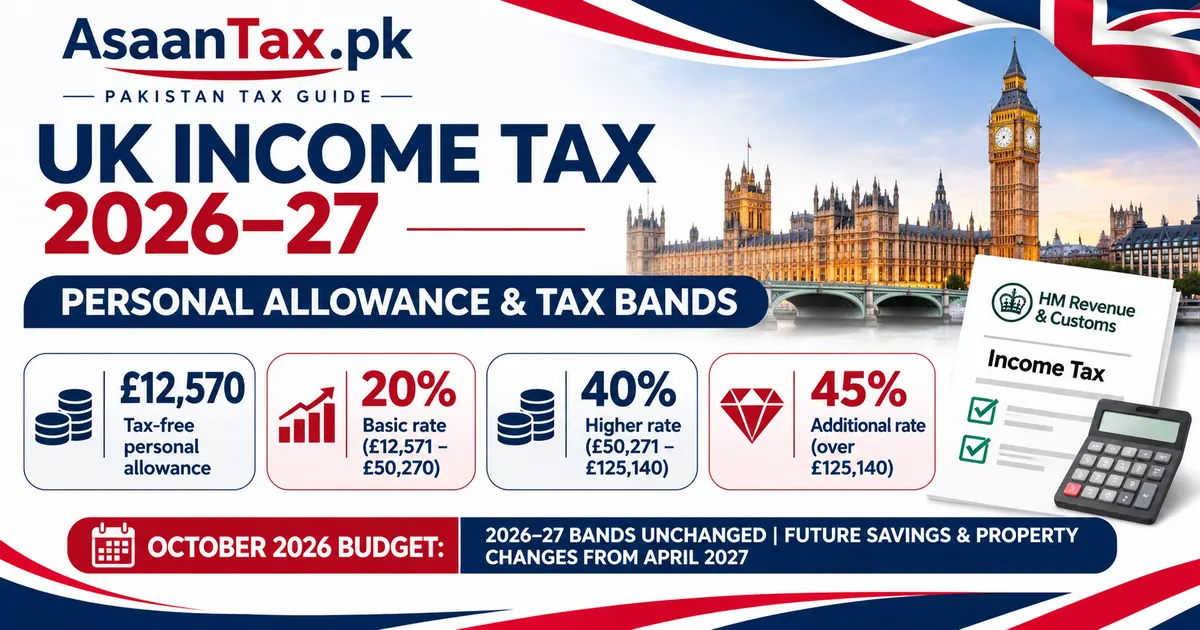
For the 2026–27 tax year, the standard UK Personal Allowance remains £12,570. In England, Wales and Northern Ireland, the main Income Tax rates remain 20%, 40% and 45%, depending on taxable income.
However, Scotland applies different Income Tax bands to employment, pension and other relevant non-savings, non-dividend income.
The UK Government's October 28, 2026 Budget also announced important tax policy changes, particularly affecting savings income, property income and the future trading allowance.
Important clarification: The October Budget did not retrospectively replace the standard 2026–27 employment Income Tax rates. Many of the announced changes apply from April 6, 2027.
This complete guide explains current tax bands, Personal Allowance reductions, salary tax calculations, Scottish rates, dividend taxes, savings allowances, Self Assessment deadlines and the key October Budget changes.
1. UK Income Tax Rates for 2026–27
The UK tax year begins on April 6 and ends on April 5 of the following year.
For Tax Year 2026–27, the main Income Tax rates applicable in England, Wales and Northern Ireland are:
| Annual Income Band | Tax Rate |
|---|---|
| Up to £12,570 | 0% — Personal Allowance |
| £12,571 to £50,270 | 20% — Basic Rate |
| £50,271 to £125,140 | 40% — Higher Rate |
| Above £125,140 | 45% — Additional Rate |
These are progressive tax rates.
A person earning £60,000 does not pay 40% on their entire salary. The 40% rate applies only to income falling within the higher-rate band.
The rates above assume the taxpayer qualifies for the standard Personal Allowance, has no relevant adjustments and is not subject to Scotland's separate non-savings Income Tax bands.
2. What Is the UK Personal Allowance in 2026–27?
The standard Personal Allowance is £12,570.
This is normally the amount of taxable income an individual can receive before paying Income Tax.
Example
An employee earns £25,000 per year.
Standard Personal Allowance: £12,570.
Income above the Personal Allowance:
£25,000 − £12,570 = £12,430.
Assuming the employee is subject to the basic rate throughout:
£12,430 × 20% = £2,486.
Estimated annual Income Tax: £2,486.
This is an Income Tax illustration only. National Insurance contributions, pension deductions, student loan repayments and other adjustments are not included.
3. Personal Allowance Reduction Above £100,000
The UK Personal Allowance is gradually reduced when adjusted net income exceeds £100,000.
HMRC reduces the allowance by £1 for every £2 of adjusted net income above £100,000.
When adjusted net income reaches £125,140, the standard Personal Allowance is completely removed.
Example: Annual Income of £110,000
Amount above £100,000:
£110,000 − £100,000 = £10,000.
Reduction in Personal Allowance:
£10,000 ÷ 2 = £5,000.
Remaining allowance:
£12,570 − £5,000 = £7,570.
Available Personal Allowance: £7,570.
This taper can create a particularly high effective marginal Income Tax rate for income between £100,000 and £125,140.
For an employee otherwise subject to the 40% higher rate, the effective marginal Income Tax rate in this taper range can be approximately 60%, before considering National Insurance or other relevant circumstances.
4. UK Income Tax Calculation Examples for 2026–27
The following examples use ordinary employment income in England, Wales or Northern Ireland, with a standard Personal Allowance and no other taxable income or adjustments.
| Annual Salary | Estimated Income Tax |
|---|---|
| £20,000 | £1,486 |
| £30,000 | £3,486 |
| £40,000 | £5,486 |
| £50,000 | £7,486 |
| £60,000 | £11,432 |
| £80,000 | £19,432 |
| £100,000 | £27,432 |
These figures exclude National Insurance contributions and other deductions.
Example: £60,000 Annual Salary
Personal Allowance: £12,570.
Basic-rate taxable income: £37,700.
Basic-rate tax:
£37,700 × 20% = £7,540.
Higher-rate income:
£60,000 − £50,270 = £9,730.
Higher-rate tax:
£9,730 × 40% = £3,892.
Total annual Income Tax: £11,432.
Example: £100,000 Annual Salary
Basic-rate tax: £7,540.
Higher-rate tax:
£49,730 × 40% = £19,892.
Total annual Income Tax: £27,432.
At exactly £100,000 of adjusted net income, the standard Personal Allowance has not yet begun to reduce.
5. Scottish Income Tax Rates 2026–27
Scotland has a separate Income Tax structure for relevant non-savings, non-dividend income.
For the 2026–27 tax year, Scottish rates are:
| Income Band | Rate |
|---|---|
| Up to £12,570 | 0% Personal Allowance |
| £12,571–£16,537 | 19% Starter |
| £16,538–£29,526 | 20% Basic |
| £29,527–£43,662 | 21% Intermediate |
| £43,663–£75,000 | 42% Higher |
| £75,001–£125,140 | 45% Advanced |
| Above £125,140 | 48% Top |
These bands assume the taxpayer receives the standard Personal Allowance.
The allowance taper above £100,000 can alter the effective taxable bands.
Why Scottish Rates Are Different
The Scottish Parliament sets the rates and bands for Scottish non-savings, non-dividend Income Tax.
However, UK-wide rules generally apply to savings income, dividend taxation and the Personal Allowance.
A person who is a Scottish taxpayer should not use the England, Wales and Northern Ireland bands to calculate all their salary tax.
6. Are Income Tax Rates the Same in Wales?
For Tax Year 2026–27, the practical main Income Tax rates for Welsh taxpayers remain:
- Basic Rate: 20%.
- Higher Rate: 40%.
- Additional Rate: 45%.
Wales operates under the Welsh Rates of Income Tax framework.
HMRC calculates the applicable rates by combining the relevant UK rates and the rates set by the Senedd.
The applicable treatment depends on the individual's Welsh taxpayer status.
7. What Changed in the October 2026 UK Budget?
The UK Government published its Budget 2026 tax policy announcements on October 28, 2026.
The official Overview of Tax Legislation and Rates was updated on November 5, 2026.
The main employment Income Tax rates and standard Personal Allowance for the existing 2026–27 tax year remained unchanged.
However, the Budget announced important future changes.
October Budget 2026: Main Income Tax Measures
| Measure | Announced Position |
|---|---|
| Personal Allowance for 2026–27 | Remains £12,570 |
| Main Employment Income Tax Rates | Remain 20%, 40% and 45% |
| Savings Income Tax From April 2027 | Proposed 24%, 44% and 49% rates |
| Property Income Tax From April 2027 | Proposed 24%, 44% and 49% rates for England, Wales and Northern Ireland, subject to devolved arrangements |
| Trading Allowance From April 2027 | Increase from £1,000 to £3,000 proposed |
| Trading Income Reporting Threshold From April 2027 | Increase to £3,000 proposed |
The forward-looking changes are linked to the Finance Bill 2026–27 and other applicable implementing legislation.
Important: Tax rules announced for April 2027 should not automatically be applied to income arising during the 2026–27 tax year.
8. New Savings Income Tax Rates From April 2027
The October 2026 Budget announced higher Income Tax rates for savings income beginning in the 2027–28 tax year.
The proposed new rates are:
| Savings Income Band | 2026–27 | From 2027–28 |
|---|---|---|
| Basic | 20% | 24% |
| Higher | 40% | 44% |
| Additional | 45% | 49% |
These changes are intended to take effect from April 6, 2027, subject to the relevant legislation.
They apply to the specified category of savings income, not automatically to ordinary employment income.
Taxpayers should also consider the Personal Savings Allowance, starting rate for savings and any applicable ISA treatment.
9. Property Income Tax Changes From April 2027
The October 2026 Budget also announced distinct rates for property income from April 6, 2027.
The proposed property income rates are:
- Basic Rate: 24%.
- Higher Rate: 44%.
- Additional Rate: 49%.
The UK Government's October announcement identifies these rates for England, Wales and Northern Ireland, while recognising devolved arrangements concerning property taxation.
Landlords should therefore distinguish between:
Tax Year 2026–27: Existing applicable Income Tax rules.
Tax Year 2027–28: Announced separate property income rates, subject to the final legislation.
A landlord should not simply apply a 24% basic rate to 2026–27 rental income because of the October 2026 announcement.
10. Dividend Tax Rates for 2026–27
Dividend income is subject to its own tax rates.
The dividend tax-free allowance for 2026–27 is £500.
For dividends above the relevant allowance, the rates are:
| Income Tax Band | Dividend Tax Rate |
|---|---|
| Basic Rate | 10.75% |
| Higher Rate | 35.75% |
| Additional Rate | 39.35% |
The basic and higher dividend rates increased compared with 2025–26.
Example
A shareholder receives £3,000 in dividends, all falling within the basic dividend rate after considering their other income and allowances.
Dividend Allowance: £500.
Taxable dividends:
£3,000 − £500 = £2,500.
Dividend Income Tax:
£2,500 × 10.75% = £268.75.
Illustrative dividend tax: £268.75.
The actual amount depends on the individual's total income, available Personal Allowance and applicable tax bands.
Dividends held within qualifying ISAs are subject to different treatment.
11. Personal Savings Allowance 2026–27
The UK Personal Savings Allowance can allow eligible taxpayers to receive a certain amount of savings interest without Income Tax.
The ordinary thresholds are:
| Taxpayer Band | Personal Savings Allowance |
|---|---|
| Basic Rate | £1,000 |
| Higher Rate | £500 |
| Additional Rate | £0 |
Eligible low-income taxpayers may also benefit from the separate starting rate for savings.
The Personal Savings Allowance does not mean all savings interest above these amounts is taxed at one flat rate.
The individual's other income and the applicable savings tax bands must be considered.
12. Income Tax for UK Freelancers and Self-Employed Individuals
Self-employed individuals generally calculate Income Tax using taxable business profits rather than gross business turnover.
For Tax Year 2026–27, the standard Personal Allowance and main Income Tax bands may apply to eligible taxpayers in England, Wales and Northern Ireland.
Scottish residents must consider Scotland's separate rates.
Example
A self-employed consultant has:
- Gross business revenue: £65,000.
- Allowable business expenses: £20,000.
- Taxable business profit: £45,000.
Assuming no other taxable income or adjustments, the simplified Income Tax calculation is:
£45,000 − £12,570 = £32,430.
£32,430 × 20% = £6,486.
Illustrative Income Tax: £6,486.
This excludes National Insurance contributions and other potential adjustments.
The October 2026 Budget also proposed increasing the trading allowance and reporting threshold from April 2027. Those prospective changes should not be applied retrospectively to the 2026–27 tax year.
13. National Insurance Is Separate From Income Tax
Many employees confuse Income Tax with National Insurance contributions.
In the UK, these are separate deductions.
An employee's take-home pay may be affected by:
- Income Tax.
- Employee National Insurance.
- Pension contributions.
- Student loan repayments.
- Other applicable payroll deductions.
Therefore, an Income Tax calculation alone does not determine the employee's final net salary.
For precise take-home pay, the relevant National Insurance thresholds and payroll conditions must also be considered.
14. How Do Employees Pay Income Tax in the UK?
Most employees pay Income Tax through the Pay As You Earn (PAYE) system.
Under PAYE, employers generally calculate and deduct Income Tax from employee wages and report payroll information to HMRC.
The tax code helps determine how an employee's allowances and adjustments are applied.
Common PAYE Considerations
- Whether the tax code is correct.
- Whether the employee has multiple jobs.
- Whether taxable benefits are included.
- Whether the Personal Allowance is reduced.
- Whether pension contributions affect taxable pay.
- Whether other income creates additional tax obligations.
Taxpayers can review their tax code and relevant records using official HMRC services.
15. UK Self Assessment Filing Deadlines
Some taxpayers need to submit a Self Assessment return.
This can include certain self-employed individuals, landlords and people with other income requiring declaration.
For the 2026–27 tax year, which ends on April 5, 2027, the standard deadlines are generally:
| Requirement | Deadline |
|---|---|
| Tax Year Ends | April 5, 2027 |
| Notify HMRC if Newly Required | October 5, 2027 |
| Paper Return | October 31, 2027 |
| Online Return | January 31, 2028 |
| Balancing Tax Payment | January 31, 2028 |
The normal deadlines may be affected by specific circumstances or HMRC notices.
Important Date Clarification
The October 31, 2026 paper filing deadline and January 31, 2027 online filing deadline generally concern the earlier 2025–26 tax year, not the 2026–27 tax year.
Taxpayers must ensure they select the correct tax year when filing.
16. Do Overseas Pakistanis Pay UK Income Tax?
Pakistani nationals living or working in the United Kingdom may be subject to UK Income Tax depending on tax residency and the source of their income.
The correct treatment depends on factors including:
- UK tax residence under the Statutory Residence Test.
- Employment location.
- Business activities.
- UK-source rental income.
- Relevant foreign income.
- Available reliefs and exemptions.
- Applicable double taxation agreements.
Pakistan–UK Double Taxation Agreement
Pakistan and the United Kingdom have a tax treaty designed to address certain cases of double taxation.
However, the availability of treaty relief depends on residency, the type of income and the treaty's specific provisions.
Being a Pakistani citizen does not automatically exempt someone from UK Income Tax.
Similarly, receiving income in Pakistan does not always establish that the income is outside the UK tax system.
For cross-border tax questions, taxpayers should consult applicable UK and Pakistan legislation and the treaty.
17. How Can UK Taxpayers Reduce Income Tax Legally?
Taxpayers may be able to reduce their Income Tax liability through legitimate reliefs and allowances.
Examples include:
Pension Contributions
Eligible pension contributions can provide tax relief, subject to applicable rules and limits.
Marriage Allowance
Qualifying married couples and civil partners may transfer part of the Personal Allowance where the statutory conditions are met.
Gift Aid Donations
Eligible charitable donations may produce tax relief, depending on the taxpayer's circumstances.
Employment Expenses
Certain qualifying work-related expenses may be deductible.
Self-Employment Expenses
Business owners may claim allowable business expenses when calculating taxable profits.
Savings and Dividend Allowances
Applicable tax allowances can reduce the amount of savings or dividend income subject to tax.
Tax planning should reflect genuine transactions and statutory rules rather than artificial income arrangements.
18. Common UK Income Tax Mistakes to Avoid
- Applying 40% Income Tax to an entire salary once income exceeds £50,270.
- Assuming the Personal Allowance is available in full above £100,000.
- Using England's bands for Scottish employment income.
- Confusing gross business revenue with taxable profit.
- Forgetting that dividend tax rates differ from employment tax rates.
- Applying April 2027 savings tax changes to the 2026–27 tax year.
- Assuming the October 2026 Budget increased current-year employment tax bands.
- Confusing National Insurance with Income Tax.
- Selecting the wrong Self Assessment tax year.
- Ignoring tax code errors.
- Overlooking additional taxable income.
- Assuming foreign or overseas income is automatically exempt.
- Claiming expenses that do not meet HMRC requirements.
- Using an outdated Self Assessment filing deadline.
19. UK Income Tax Checklist for 2026–27
Before preparing a tax calculation or return, verify:
- The relevant UK tax year.
- Whether the taxpayer is a Scottish taxpayer.
- The standard or adjusted Personal Allowance.
- Employment and pension income.
- Self-employment profits.
- Rental income.
- Savings interest.
- Dividend income.
- Available deductions and allowances.
- Tax already deducted through PAYE.
- National Insurance obligations.
- Relevant overseas income.
- Self Assessment registration requirements.
- The correct filing and payment deadlines.
- Whether any announced Budget changes actually apply to the relevant tax year.
20. Watch Tax With Naeem — Tax Return Filing and Income Reporting
For general educational guidance about income tax returns, salary income, rental income, capital gains and dividends, you can watch content from Tax With Naeem.
Related Video: Income Tax Return Filing in Pakistan — Salary, Rental Income, Capital Gains and Dividends Explained
https://www.youtube.com/watch?v=VX88o1N1AfA
This is a Pakistan income tax education video, not a dedicated UK HMRC tax tutorial.
The principles of identifying different sources of income can be educational, but Pakistani tax slabs, filing systems and legal rules must not be used to calculate UK tax liabilities.
For UK-specific calculations, readers should follow official HMRC guidance.
21. Official UK Government Sources and References
1. HMRC — Income Tax Rates and Personal Allowances
https://www.gov.uk/income-tax-rates
2. HMRC — Income Tax Rates and Allowances 2026–27
3. HM Treasury and HMRC — Budget 2026 Tax Legislation and Rates
https://www.gov.uk/government/publications/budget-2026-overview-of-tax-legislation-and-rates-ootlar
4. Budget 2026 — Detailed Tax Measures
5. Scottish Government — Income Tax Rates and Bands 2026–27
https://www.gov.scot/publications/scottish-income-tax-rates-and-bands/pages/2026-to-2027/
6. HMRC — Dividend Tax
https://www.gov.uk/tax-on-dividends
7. HMRC — Self Assessment
https://www.gov.uk/self-assessment-tax-returns
8. AsaanTax.pk — International Tax Guides
9. Tax With Naeem — Income Tax Tutorial
https://www.youtube.com/watch?v=VX88o1N1AfA
22. Conclusion: What Are the UK Income Tax Rates for 2026–27?
For Tax Year 2026–27, the standard UK Personal Allowance remains £12,570.
The main employment Income Tax rates in England, Wales and Northern Ireland remain 20%, 40% and 45%, while Scotland has separate rates and bands for relevant non-savings, non-dividend income.
People with adjusted net income above £100,000 should pay particular attention to the gradual withdrawal of their Personal Allowance.
The October 28, 2026 Budget did not retrospectively increase the 2026–27 main employment Income Tax rates, but it announced important changes for subsequent tax years.
From April 2027, higher savings income rates, separate property income rates and changes to the trading allowance are among the measures announced, subject to the applicable legislation.
The key is to distinguish the current 2026–27 tax rules from the changes scheduled for 2027–28.
For more practical guides on UK taxation, UAE Corporate Tax, international tax compliance and Pakistan FBR rules, visit AsaanTax.pk.
Editorial Note: This guide reflects HMRC and UK Government information available through November 10, 2026. Forward-looking Budget proposals are identified separately from rules already in force.
Disclaimer: This article provides general educational information and is not personalized UK tax advice. Tax liabilities vary depending on income type, tax residency, allowances, reliefs and other circumstances. Readers should consult HMRC or a qualified UK tax adviser for individual cases.